
Posts Tagged ‘life coach’
Coping With Family Stress To Bring Peace To The Holidays

Coping with family stress during the holidays can seem like a given. Many of us anticipate that family will get on our nerves, make us upset, or get us angry. Understanding that stress, especially during the holidays, will happen, then coping with family stress becomes more manageable and doable since we expect to feel and experience that family stress.
Coping with family stress comes with the season. Sure, family stress happens all year. Still, during the holiday season, it amps up, becoming stronger and more widespread amongst families. Family stress is defined as a disturbance in the steady-state of the family system. The disturbance can emerge from the outside, from inside the family, or both simultaneously.
Why does this happen? Why during a time of the year when we try to be cheerful and happy are families more stressed?
I feel that the answer to that question is two-fold. The holiday season itself can cause stress. Families need to make preparations for travel, the arrival of other family members, meal prep, getting gifts, decorating, and meeting the expectations of traditions. There’s a lot of responsibility placed on many people during a short couple of months. But we all know how the family will talk for years to come if just one aspect of the holidays doesn’t go as they wanted or expected. That’s a lot of pressure to place on people.
Bonus: Download Chris Shea’s booklet on Life Coaching & is it for me? Click here to get it
The other part of the answer to the question is that families who may spend much of the year physically separated are now coming back together. Children out on their own for the first time, feeling that sense of freedom, are now back in their parent’s house, struggling with being an adult while once again being treated like a child. Or family members who get along well through phone or video chats, find that living under the same roof, even temporarily, is a reminder of why they moved away.
Put these two reasons together, not unlike distant family members coming together, and we have the answer as to why coping with family stress is such an issue this time of the year. Tensions are high to achieve perfection, and family members are moving back, the perfect storm in which to brew stress.
So what can we do about this? Do we resign ourselves to an uncomfortable holiday as we assume stress to be inevitable? Not at all. Actually, the “answer” starts with the formulation of the question itself.
Expectations
If you know there will be family stress during the holiday, base your expectations as such. If you know that one uncle will be drunk once again, or that cousins whom you can’t stand will be at a function, base your expectations as such. If that uncle gets drunk every year, don’t act surprised when he does it yet again. Why would you expect him to act any differently? Enter the holiday season with realistic expectations as to how people will act and plan accordingly. Therefore no surprises or hurt feelings. Actually, if for some reason they act in a healthy way, such as not getting drunk, then you’ll be pleasantly surprised. Keep your expectations realistic. No family is or will ever be perfect.
Feelings
I write and often speak on this topic of feelings and how no one makes us feel any such way. Our nature tends to seek blame for when we don’t like how we are feeling. If I’m feeling happy or joyous, I’ll own that feeling! I’ll tell everyone how “I” feel. But, if I’m angry or sad or disappointed, I need to find the person or situation for which I can blame for those feelings. So if I’m disappointed in how the family gathering is progressing, I’ll be sure to vocalize how uncle so-and-so “made” me feel. Yet, in reality, no one makes us feel anything. People act, we react. But we have a choice in our reaction. If I kept my expectations based on reality, and uncle so-and-so is once again ruining the evening, I can choose to feel what I want since I already prepared myself for his actions. I don’t have to feel disappointed. And if I do feel frustrated, that’s my choice, just as it’s your uncle’s choice to do his actions.
It’s OK
When you’re creating your realistic expectations, remind yourself that it’s OK to feel how you feel. And it’s OK if not every family member agrees with the other members. A family’s bond is not in agreement with everyone, the relationship is in the love and the connections of the members. Yet, since each member of the family is an individual person as well, they may have different thoughts and opinions from others in the family. Remind yourself that it’s OK. Just as each family member has their own views, so too, you have your own opinions and feelings. You don’t have to convince others as to your opinion, nor do you have to justify your feelings. Be yourself, yet understand that as a member of the family, the family itself has importance. As you accept others in the family, accept yourself as a member too.
{loadmoduleid 140}
How To Find Hope In Life

How to find hope in life is not always an easy task. Yet, a life without a sense of hope can be dark, depressed, anxious, and lacking in motivation. In this article, I write about ways of finding hope in life, and so finding happiness and inner peace.
To find hope and to keep hope are essential to living a happy and peaceful life. Yet most of us know what it’s like to live a life devoid of hope. A life where nothing seems to be going our way, and no one seems to understand. The encouraging “you’ll snap out of it,” or “sleep it off,” or, my favorite, “just get over it,” is not at all helpful. If only it were that easy to overcome the feeling of hopelessness.
Hope is a mechanism developed by the human brain to cope with contexts and situations unfavorable to survival. Without a sense of hope in the future, or hope in one’s ability, where would we find our motivation, our drive, to move forward? In the worst of times, it’s hoping that drives me forward. That “knowledge” telling me there is something better in the future if only I get there. Hope compels me to find the impossible as possible because I believed it to be possible and so acted as if the possible were already the reality.
Bonus: Download Chris Shea’s booklet on Life Coaching & is it for me? Click here to get it
The author and evangelist Hal Lindsey says it so well: “Man can live about forty days without food, about three days without water, about eight minutes without air…but only for one second without hope.” Here are some of my suggestions to find hope in life:
- Do what you know you can do. Take steps forward by accomplishing the tasks you know you can achieve. Maybe you can make the bed, or actually get out of the bed, celebrate the little wins as eventually, these wins will become the lessons needed to find hope.
- Perform an act of kindness. Helping someone else not only shows them there are good people in the world but gives you a sense of accomplishment and outward pride in supporting a fellow human. This sense of pride, felt healthily, will lead to a feeling of hope, knowing that if you can help someone else, you can help yourself, too.
- Surround yourself with optimism. The attitudes of people around us influence our mood. If you surround yourself with positive and hopeful people, you, too, will become positive and optimistic. Learn who the positive people are in your life and follow them.
- Allow for inspiration. Read inspirational books or quotes, strengthen your faith, return to your place of worship, whatever it takes to believe and feel the presence of a being more significant than yourself. Knowing that a prayer community is willing to help you, and the belief that something out there is higher than you, gives us hope in that we aren’t alone.
- Spend time in nature. Feeling, seeing, sensing the depth of the beauty of nature is awe-inspiring. Notice the small insects and bugs, reflecting on how they, given their size and lack of intelligence, somehow survive and even thrive in their environment. If the insect can do it, you can do it!
How to find hope in life is necessary for us to move forward in life, to find the motivation to grow and mature into the best person you can be. Don’t let yourself lose hope. Hold on tightly, and try to enjoy the ride.
{loadmoduleid 140}
How To Overcome Fear But We Need Fear To Live
To overcome fear, one needs to believe they will be happy on the other side, and that getting to the other side of fear is possible. Knowing and believing are two very different attitudes. In this article, I use my own childhood fear as an example throughout. Keep in mind, we need fear to live, so be careful in what fear you try to overcome.
As a young child, I had many fears, as I’m sure most children experience. For me, my most significant event to overcome fear was the weather, specifically thunderstorms. I was convinced that every storm would spawn a tornado which would ultimately find and pulverize my house, with me in it! Now, please know that I did not grow up in tornado alley or in a tornado prone area. Yes, we experienced the random water spout and once a decade, or so a tornado would develop. The tornadoes were far enough from my house not to see the funnel of destruction but close enough that the local newspaper printed articles about the twister.
I have no idea of the origin of my fear, but I knew exactly how to overcome fear in this situation. To overcome fear is not easy, primarily when our fear is rooted in reality. In my childhood situation, the fact was that tornadoes did happen in my area, do spawn from thunderstorms, and are capable of demolishing houses. Therefore, to that extent of reality, my fear was justified.
Yet there’s another perspective, or reality, to be examined if we want to overcome fear. In my case, reality also demonstrated that a tornado never formed in my neighborhood, at the time I had never seen a tornado, and in my 18 years growing up in my childhood home, it was never demolished by a tornado (actually that home still stands to this day). So yes, there was a reason for my fear, but also yes, my childhood fear was unfounded.
Bonus: Download Chris Shea’s booklet on Life Coaching & is it for me? Click here to get it
Fear is powerful, convincing us to either flee or fight against a known or unknown danger waiting to harm us. The threat, for our first ancestors, was primarily focused on physical survival issues, life, and death situations. Today our fears tend to be focused on emotional survival issues. Emotional survival is as essential to our overall survival as is physical survival. Fear is instinctual as a means to protect us in situations where protection is needed so that we survive and reach the other side of that which was threatening.
Since fear serves to protect us from both physical and emotional harm, guiding us along a path of survival, why then even talk about how to overcome fear? Shouldn’t we embrace fear as our protector? Fear is actually not our problem, as such, I should change the title of this article. The problem we have is how we cope with our fear. The initial reaction to either flee or fight is helpful, but becoming stuck in either mode is detrimental to moving forward. It’s so much easier to flee or fight when the situation is physical. Yet when the threat is emotional, fleeing or fighting is more difficult to notice, and so we become stuck.
As a child, my response to thunderstorms was to hide under my bed or to run into the basement. The latter is the preferred location if there actually were a tornado present, yet for me, it was an escape, a fleeing, to where I felt safe. My becoming stuck was not fleeing to the basement, but doing so, when there was no need to do so. I would leave friends, activities, family, etc. to flee to the imagined safety of the basement. Fleeing when it leads to safety is healthy and wise; fleeing solely out of fear is unhealthy and being stuck.
What have I learned from my childhood into adulthood on how to overcome fear?
- Reflect: When you feel afraid, take action to protect yourself. After you’ve acted, reflect on yourself and the situation to determine if your response to your fear is healthy or not, using the example I gave above.
- Act: Take action, not to overcome fear, but to overcome your unhealthy response to fear. As I grew older, and while hiding in the basement, I happened upon a very old book set somewhat hidden under my Dad’s tool bench. As I uncovered the books, I noticed that one of the books was about the weather, explaining the forces and science behind how the weather works and safety tips. My action was in learning about that which I feared, causing me to have a respectful fear of Mother Nature. I now know when seeking shelter and being afraid is necessary and when it’s not. As an adult, I now spend free time chasing storms. I enjoy sitting on my deck to watch the beauty of the lightning show, and I’ve even been in storms which spawned tornadoes that I was able to see. Some of these experiences produced no fear in me while others produced much fear, and healthily, I respected the power of nature and took shelter.
- Fight: Fight within yourself to believe that you can overcome your fear. When I first started to learn about the weather I “knew” I could handle my fear, yet it took years of maturing and study to “believe” that I could overcome fear and respond healthily. Start with “knowing” but continue to fight and work until you get to “believing” in yourself.
- Flee: It’s important not to think of fleeing with a negative connotation. Fleeing from a harmful situation is wise for survival and for providing time to create a plan of action. In modern life, physically fleeing, or leaving a person or condition may be the healthiest action to take for your own emotional well-being. Similarily, emotional fleeing from a situation, controlled and not permanent, can have the same healthy effect as does physical fleeing. Keep in mind that healthy or unhealthy flight is dependant upon your motivation and the reality of the threat. An emotionally abusive relationship might require a person to flee physically. Yet a person who simply doesn’t like a situation, their fleeing may be an unhealthy escape. Sometimes circumstances may be able to be fixed if you stay and fight.
Yes, we need fear to live and survive, but how we respond to our fear is what makes the difference in our emotional health. If you want to live a happy and peaceful life, practice believing in yourself that you can overcome fear by the way you cope with your fear.
{loadmoduleid 140}
How To Not Sweat The Small Stuff And Find Happiness
Learning to not sweat the small stuff is a phrase filled with much wisdom. The important piece to this statement is learning to live in the moment. But how can we learn to stay more in the moment so that we don’t let the little things bother us so much that we lose our happiness? Here is my technique on how to not sweat the small stuff.
Step one is to actually reframe the question of how not to sweat the small stuff. If something is bothering someone, then it’s not “small stuff” to them. Judging another’s perception as to the gravity of a situation negates what they’re feeling and expressing. Although, I do hope to eventually get them to a point in the future where they can laugh at it and say, ah, that really was small.
But, to not sweat the small stuff, to get to the point of recognizing the smallness of some of our concerns, the question I’ll ask the client is “in the scope of everything going on in your life and in the world today, where does this issue fit?” If they’re honest with themselves and with me, they’ll understand the inner challenge in that question. Placing our perceived large stressor in judgment against the stressors of the world gains us a new perspective on our place within the larger community.
To clarify, I don’t typically advocate comparing one person’s troubles to another person’s troubles since we all cope in different ways, even to the same stressors. But in cases when an issue which is seemingly small yet perceived as large, then changing one’s perspective through comparison can be eye-opening and therapeutic.
When we sweat the small stuff and get stuck in our focus on anxiety, we need a strategy to guide us in healthy non-anxiety producing coping skills. The approach I use is what I affectionately call “the shiny object” strategy.
This strategy diverts our attention to focus on something different from that which is producing our anxiety, similar to shaking a shiny object in a dog’s or baby’s face to divert their attention to something else. Eventually, while diverted, we forget that which were focused on and which was causing the anxiety. This exercise guides us to reframe our perspective on ourself and our world.
Bonus: Download Chris Shea’s booklet on Life Coaching & is it for me? Click here to get it
I’ve spent a couple of decades working with people suffering from the disease of addiction, and one of their complaints to me is how their fellowship sponsor responds to them when they share they have a craving. They tell me they would call their sponsor and say, “I have a craving to use.” Invariably the sponsor would reply with something to the effect of, “Hey, did you watch the game last night?” The conversation would turn to sports, or whatever topic the sponsor wished to discuss. But it was invariably any topic other than the issue of the person’s craving to use a drug or drink.
My clients would complain that the sponsor isn’t helping when they reach out with a craving. They complain that the sponsor will talk about everything except for the reason they called, their craving. My question to the client, when they were done complaining, is always “did you use? Did you give in to the craving?” The client would always answer with one word, “no.” Isn’t that the goal the client wanted? They didn’t want to give in to their craving, and in the end, they didn’t.
This is a prime example of the shiny object theory. Keep focusing on your craving, and the craving will increase in intensity; stop focusing on your craving, and shortly, it will go away. In the same way, if I have a headache and I’m focused on my headache, my headache gets worse. If I have a headache but take care of that headache and return to my day’s activities, my headache seemingly goes away.
If someone decides to sweat the small stuff, remember that to them the issue they are sweating is not small. There is a reason they are sweating the issue, so don’t focus solely on the issue itself, rather, spend the time to learn why the issue is bothering the person the way it is.
If you’re feeling something irritating you, annoying you, bothering you, sticking with you, spend time reflecting on the deeper issues. Take time out, take a breath, focus on it, and dig in to figure out what’s happening so you can solve the root problem. When you solve the root problem, you will no longer sweat the small stuff.
{loadmoduleid 140}
Life Management Tips For A Happy Life
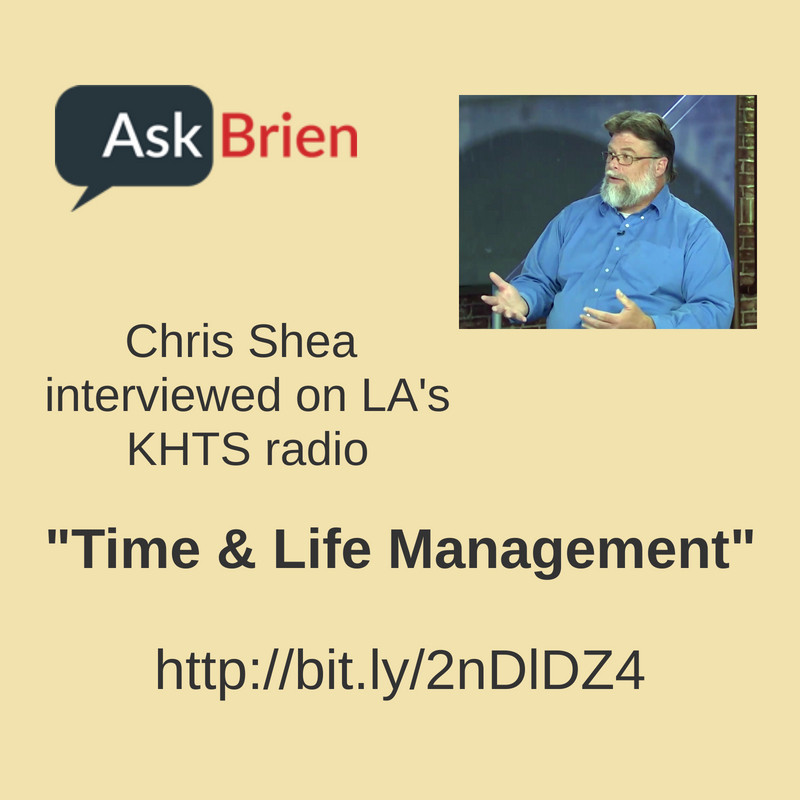
Life management became the focus of my live interview on the LA radio show “Ask Brien.” This business-focused show turned into a life coaching episode as the topic of time management easily and quickly moved into life management. Check out the full interview below.
The host asked me to define and talk about time management, especially for new entrepreneurs struggling to grow a new business while balancing their personal lives. I believe that time management consists of taking a holistic picture of what’s happening in the present moment, therefore time management is akin to life management. Time management is focusing on ways to get done what needs to now while planning for the next task.
Time management, like life management, is most effective when you approach your tasks and day with a sense of reasonable expectations. If your expectations of what and when you can accomplish tasks are unreasonable, you’re going to set yourself up for failure. The problem is you’re going to end up at the end of that day saying, not only did I not accomplish what I wanted to, but because I didn’t meet my expectations, there’s something wrong with me. This way of thinking will lead you into a downward spiral of negativity. Yet in reality, there might not be anything wrong with your approach except having too high of expectations which were totally unreasonable.
How does one create reasonable expectations? Well, you really have to get honest with yourself and figure out what you can realistically accomplish and stick to that. Often, especially with entrepreneurs who are starting out doing their own business, it’s a one-person show; they don’t have a team. Therefore, you get into the mindset that I’ve got to do everything by myself. So everything becomes a priority. So as not to burn out you really have to figure out what it is you can and can’t do.
Be honest with yourself about what you know, what you’re good at, what you can do, and what’s reasonable. Then you’ll need to come up with a solution for what needs to get done. That solution becomes part of your to do list. So I think one of the things we need to do in time management is to begin to understand those areas that I can work on and those areas where I need to find somebody else or some other business to make it happen.
Download Chris Shea’s “Business Coaching Services” booklet on why you should have Lifesjourney consult with your business: Click here to get it
Recently, I find most people are coming to me for life coaching, stating that their life is stressful, their job is the worst, or their relationship isn’t what they think it should be. This is what people are feeling, but what’s really going on is a sense of a lack of purpose in life being manifest or showing itself through stress and anxiety. People are asking the questions, “what is my life about?” “Where am I going with my life?”
An aspect of many people’s outlook that I’ve observed is a focus on the negatives of life, If you’re always looking at life as negative, you’re only going to see the negative. Those who are asking questions about the purpose in life are actually looking at the positive in life. They want answers or solutions, and by their nature, solutions are positive.
We need to change our perspective on that piece right there. There’s nothing wrong with questioning, but we also have to see life from a whole different perspective based on whatever is happening now.
We need to acknowledge what the negatives are in our life. I’m not saying to deny the negatives, that’s part of our reality, but we don’t want to just focus on them. So we can say, here are all the negatives going on in my life right now, but also, what are the positives going on in your life right now? There’s always something that you can find which is positive. I guide my clients on how to look at things differently so that they can not only find the positives but also to create the solutions.
Life management covers not only perspective and expectations but our outlook on life in general. Check out the entire interview for more information on my take on being a realist while practicing mindfulness.
{loadmoduleid 140}
Selfishness Is NOT Mindfulness: My Approach To Life Coaching
Selfishness is overwhelmingly the norm of our culture. Yet at the same time, self-help practitioners and life coaches are promoting practices such as mindfulness and self-awareness into an age of selfishness, enabling that selfishness to become the emerging goal of mindfulness. I fear that maybe my mission of life coaching is partly to blame for this selfishness, even though my approach to life coaching is very different from most coaches.
As a life coach, speaker, and author on the topic of finding inner peace through mindfulness, I fear that maybe my life’s mission is to blame for this selfishness. Have I been leading people astray? Actually, no!
A close examination of my material and mindfulness itself eschews selfishness in all of its manifestations. So why the existential angst that I’m feeling? Our culture encourages individuality, no pain, no suffering, only encouragement, praise, and a “way to go” for every action performed. Individualism based on the absence of hardship inevitably leads one to believe themselves as the center of the world. For most people, the focus is on self, and on being happy.
Insert the practice of mindfulness and the various claims from life and wellness coaches that they will make you happy, healthy, and prosperous if only you practice mindfulness in their way, and BOOM, an industry is born from the selfish tendencies of our culture.
What makes me different from other life and wellness coaches is that I do not promise you your dreams. I work in leading you to find inner peace, resulting in self-love expressed in action. My goal is not to make you healthy, thin, successful, or wealthy. Honestly, I don’t care if you succeed or fail in aspects of your life. My goal is for you to find inner peace regardless of what is happening in your life. The key to finding this peace is spelled out in my PATH program with it’s focus on teaching you to shift your priorities and perception.
The issue of selfishness is not because of mindfulness, the problem is in the promises being made about success, health, and happiness. In a previous article, I wrote against this idea of seeking happiness as a life goal.
Bonus: Download Chris Shea’s booklet on Life Coaching & is it for me? Click here to get it
Historically, the arrival of mindfulness to the US is attributed to Jon Kabat-Zinn. In 2013 Kabat-Zinn wrote this definition of mindfulness (bold mine): “Mindfulness is the psychological process of bringing one’s attention to the internal and external experiences occurring in the present moment, which can be developed through the practice of meditation and other training.”
According to Robert Sharf, “the Buddhist term translated into English as ‘mindfulness’ originates in the Pali term sati and in its Sanskrit counterpart smṛti. Smṛti originally meant ‘to remember,’ ‘to recollect,’ ‘to bear in mind’. … [S]ati is an awareness of things in relation to things, and hence an awareness of their relative value. Sati is what causes the practitioner of yoga to ‘remember’ that any feeling he may experience exists in relation to a whole variety or world of feelings that may be skillful or unskillful, with faults or faultless, relatively inferior or refined, dark or pure.”
Where in this ancient or current definition of mindfulness does one find selfishness? One doesn’t, for what is written is quite the opposite of selfishness. Reflecting on the phrases, I placed in bold, we see that mindfulness is focused on one’s entire experience of life, not just the happy moments, thoughts, or emotions. As professor Thomas Joiner writes: “Accepting one’s thoughts as mere thoughts is very different from treasuring one’s thoughts; one may as well treasure one’s sweat or saliva. This is about recognizing that each thought is inconsequential and thus not worth getting depressed or anxious about.”
The goal of mindfulness is for us to slow down enough to fully experience life. Mindfulness is not a means to avoid negative aspects of life, but to fully live those experiences to learn how to cope with them healthily. Mindfulness asks us to be aware of all of our emotions, to feel everything, even the negativity. In so doing, we end up coping with what we at first wanted to avoid.
Mindfulness does not lead us away from reality into false or naive happiness; instead, it immerses us into our present reality. Mindfulness only talks about the self in the context of the necessary inward reflection. But to stay in the inward self is what makes one selfish. Selfishness does not and cannot lead to a sense of inner nor outer peace!
Why? Because the state of being at peace involves one’s actions becoming in sync with one’s values and morals. The ideology of morality exists in light of our interactions within a culture of other people. Separating oneself (selfishness) from society implies no need for a set of morals as there is no one upon whom you will transgress.
Therefore, finding inner peace directs one to seek an outer peace, and for that to happen, we need to work together for the common good; an anti-selfishness. Working together for the common good involves action, and action is as necessary as the practice of mindfulness itself. We aren’t utilizing mindfulness as a tool for merely learning about self for the sake of knowledge, but for that knowledge to help us understand our place in the broader community. Mindfulness guides me to be the best version of me, not for me to hold onto, but for me to share my best version of self with the community.
Living mindfully is a daily practice of noticing everything. The emphasis is on full awareness of our experience to avoid denial of reality. Mindfulness, when used as intended, will lead one to a deeper understanding of self and the experience of inner peace. But mindfulness does not result in selfishness or personal gains, save the personal benefit of more profound knowledge as to who you are. Mindfulness and inner peace lead us outside of ourselves to working with others in creating a just and peace-filled world, something selfishness knows nothing about.
{loadmoduleid 140}
How I Cope With Chronic Pain Management Using Mindfulness

Unfortunately, many people struggle with chronic pain management, as do I. Over time I’ve gained insights into what techniques work for me and which don’t work. Much of the content of my life coaching message comes from my personal pain management struggles. One thing I have learned with certainty, there are ways to manage pain and discover pain relief daily.
Pain, whether it be physical or emotional, is unavoidable. As I write this, about seven years ago I was diagnosed with fibromyalgia, an overall body pain due to overstimulated nerves. It took a while to find that diagnosis and a couple of years more to find the right combination of medications. I’ve reflected much on pain and how best to live with chronic pain, gaining insights into chronic pain management, yet the learning continues.
We try our best to avoid pain, almost at all costs. Personally and as a society, we make every effort imaginable to avoid, end, or numb, all pain. Yet, the more we try, I feel the more we end up still in pain and not feeling at peace or happy. According to the US Centers for Disease Control & Prevention, “In 2012, health care providers wrote 259 million prescriptions for opioid pain medication, enough for every adult in the United States to have a bottle of pills.” This reality is one of the reasons we have the current opioid crisis as narcotic pain medicines are addictive, even when taken as prescribed. Yet there’s a better way to deal with the pain rather than medicating our way out of it.
In my experience, I ask what I feel is the central question “Why do we feel pain?” Maybe if we understood the “why” we would better understand how best to cope with pain.
According to Barbara Finlay “The basic function of pain is the same for all vertebrates: it alerts an animal to potential damage and reduces activity after trauma.” In other words, pain is necessary as it alerts us to a problem we need to address. For example, continuing to walk on a broken leg causes more damage to the leg. The pain of the fractured leg forces us to stop and adequately deal with the break. The same is true when we are feeling emotional pain, all too common for us who live with chronic pain. Our emotional pain warns us that we need to take care of ourself by pausing to deal with the cause of the pain. If we choose to ignore the root cause of our emotional pain, as with our physical pain, we will live thinking and feeling in unhealthy ways, never feeling better or at peace.
Bonus: Download Chris Shea’s booklet on Life Coaching & is it for me? Click here to get it
So why is it that we spend copious amounts of energy and money to avoid pain? If pain is necessary for our physical and emotional well being, why do we fight so hard to get rid of it? Don’t misinterpret what I am saying, for I am not saying pain itself is to be desired! Instead, I am saying that pain is a part of our life, and so learning to cope with pain instead of numbing or avoiding pain will lead us to physical and emotional health and peace.
In an article titled “How To Stop Using Hunger To Numb Your Emotions,” a podcast guest of mine, Brandilyn Tebo writes: “I fundamentally believed that I was not allowed to have what I really wanted until I proved that I was’ worthy’ enough. So I would rather numb my desires than feel them because not feeling anything was easier than wanting the fulfillment that I couldn’t have.”
Brandilyn’s description of numbing her pain hits close to home. Daily chronic pain takes a toll on us emotionally as we physically struggle with everyday tasks, while at the same time wondering why we’re different, why me, why this? The feelings and thoughts we have are meant to be felt so that we can find meaning out of our suffering.
Suffering without meaning is a waste, but suffering, when we allow it to teach us leads us more deeply into ourselves. We begin to understand that we too have a place in the world; we also have a purpose. Finding our purpose gives us a reason to keep going!
Our (my) desire to not feel tricks us into believing that life is somehow more comfortable. But in not feeling we aren’t coping with the deeper issue, we’re simply ignoring the pain. As we numb the pain, we take away our power to cope with our pain, and healing doesn’t take place. Not unlike a broken leg numbing the pain does not heal the leg nor deal with the cause or issue of our suffering.
Learning how best to cope with pain is not easy, but is doable and essential if we wish to feel peace, happiness, and freedom. Those times when my pain is so intense that I literally can’t get out of bed or get to work are not just physically painful. Realizing that I can’t do what I used to do because of some stupid illness turns the frustration to anger, an anger I turn on myself until it morphs into a depressive pitty party. This is a dark place many of us know all too well.
Yet, when we find purpose and meaning in our life, those times of intense pain and darkness can be pushed aside, replaced by the desire to regain my power so I can fulfill my purpose. I know, trust me, that this is easier said than done, as it demands an inner strength to replace the darkness with the light of a life lived on my terms, not the illness’ terms.
Here a few strategies I have learned which help me cope with my pain:
- Acknowledge the pain. Avoid the temptation to numb the pain. Instead, recognize that the pain is telling you something. Reflect on the cause of the pain and look at ways you can change your thoughts and emotions about the pain.
- Realize that you are not alone. Understand that what you are experiencing is also experienced by many others. There is no pain that only one person in this entire world suffers from. Seek out others who daily struggle with coping from a similar illness. Console and aid each other. When we help others, we feel better about ourselves. Seek out support groups, online sites, chat rooms, etc.
- Embrace your true self. Acknowledge to yourself that you aren’t perfect and that there are aspects of yourself in need of improvement. Yet, at the same time, there are aspects of yourself which are good and healthy. No one is perfect; we all have our flaws. Embrace that which you wish to numb, then do the work needed to make changes in your life. “I thought that if I allowed the rejected parts of myself to be expressed, that I would lose myself. What I discovered was that only through facing and eventually embracing these parts of myself did I truly find myself.” (Brandilyn Tebo)
There is so much more I could say about pain and my experiences, but for the goal of this article, I’d like to end with a quote from the author and priest Henri Nouwen: “Consolation is a beautiful word. It means “to be” (con-) “with the lonely one.” To console does not mean to take away the pain but rather to be there and say, “You are not alone, I am with you. Together we can carry the burden. Don’t be afraid. I am here.” That is consolation. We all need to give it as well as to receive it.”
{loadmoduleid 140}
How To Stop Blaming Others For The Opioid Epidemic
The blame game is alive and well, but we need to stop blaming others. The opioid epidemic grows while we as a society are blaming others and judging those who are addicted to the opioid drugs. We must work together for a viable resolution to this epidemic, and here are my suggestions.
It appears to be human nature for us to want to find a reason, cause, or another person to blame for something that has happened to us or to a loved one. Think of how easy it is for us to throw blame around when we are caught practically red-handed in an act. How did we learn this?
The blame game has been with us since our earliest days of childhood. As a child, we tried the excuse that someone else made me do it to see if that excuse would work. Depending on your childhood it had varying success, yet any time that it worked we learned that blaming was a viable excuse. As we’ve grown into adulthood many of us continue to use this excuse.
Many of my clients want to find who is to blame for the way they are today. They are convinced that if they find out which parent or sibling created the current negative thoughts or behaviors all would somehow magically be well. Yet this isn’t the case, so I don’t allow my clients to go down that path.
Bonus: Download Chris Shea’s booklet on Life Coaching & is it for me? Click here to get it
When my clients, or even ourselves, wish to find someone in the past to blame for our current situation all that we are doing is avoiding our responsibility and our actions for making a change today. Even if there were someone from our past legitimately responsible and whom we could blame, how would that change who I am today? All that does is to serve as knowledge but doesn’t give me anything to do that will change how I feel or act today. Therefore, I stay away from the blame game in all situations as it serves no purpose in the present but only to educate us about the past. So even if a client’s parents were to blame for their current situation it is still up to the client themselves to make the necessary changes which will make their lives better. The same goes for the blame game when it comes to addiction and the opioid epidemic.
Over the past couple of decades, I’ve worked with thousands of people who are addicted to drugs and alcohol, guiding them into lives of recovery. Each of them needed to work on their present lives and make changes so that their recovery would be a daily way of life. Blaming their families, communities, doctors, or Pharmaceuticals only serves to focus our anger away from what needs to be dealt with at the present moment. At this moment we need to take action and make changes as a society or else this opioid epidemic will not end.
I don’t write this out of a naive ignorance to the societal factors and big business practices which led to the epidemic and opioid overdose deaths we are encountering today. I can make a very long list of who I would blame for this opioid epidemic, but as I’ve stated, what’s the point? What we need right now are solutions and actions to ensure that this epidemic does not become a generational epidemic.
I suggest that the first change which needs to be made is a philosophical shift in how we as individuals and society think of addiction. Many in society do not believe that addiction is a disease unlike any other mental health or medical disease. Their blaming the person with the addiction only serves as a moral judgment on a person’s character. Yet if that same person were to suffer from any other chronic medical disease they would receive the proper care without question and without judgment.
For example, a person who is discharged from addiction treatment and later relapses is judged for their lack of willpower and character. In many instances, they are not allowed back into treatment or they are told to find a different treatment facility. Yet a person who is discharged from the hospital recovering from a heart attack who is told what changes they need to make in their physical activity, as well as diet, are not judged or criticized if they fail to make those changes and end up with another heart attack. What’s the difference? The one person did not follow the recommendations of their treatment provider and returned to drug use while the other person did not follow the recommendations of their treatment provider and had another heart attack. Yet the person who suffers the second heart attack will be readmitted to the hospital without question nor judgment. This societal attitude must change!
What can we do to make a difference in solving this opioid epidemic? Here are my suggestions:
- Educate ourselves on the current state of the opioid epidemic and learn about your local resources available to help those suffering from addiction and struggling in recovery.
- Gather as a neighborhood or community pooling together your resources to work on viable solutions unique for your community. As a society, we need to stop saying that we want this epidemic to stop while at the same time deny the building of treatment centers or recovery housing near or in our neighborhoods.
- Doctors and Mental Health Counselors need to be educated about the addiction field and best practices for treating those who are in active recovery. As a counselor and an educator myself, I find it disheartening that the addiction courses I teach to those in the counseling profession are only electives and not mandatory courses. Medical professionals such as doctors are in the same educational situation where they may only have to take one addiction studies class in their entire career. This is not to blame either of these professions but to provide them the necessary knowledge and tools since they are in the front line of this epidemic.
- Be compassionate to those you know who are in recovery or still suffering from their active addiction, and don’t forget about their families who also need compassion and support.
If we tackle this opioid epidemic in light of its medical and mental health status we will turn this around and as a society, we will reap the rewards of a healthy populace.
{loadmoduleid 140}
How To Find Peace In The Holiday Stress
The time of the year between Thanksgiving and New Year’s Day is filled with high expectation leading us into holiday stress. The expectation for perfection is great, causing us stress and a lack of peace when we desire this to be a time of joy with the celebration of family traditions. Here are my 4 tips to find peace in the holiday stress.
This time of the year is when I reflect upon my own childhood memories; memories filled with awe and wonder as the world seemed to be magical. Unfortunately, this time of the year is also one of increased holiday stress due to all the activities we feel we need to do. Our wish to make this time of the year “perfect” increases our expectations, many of them unreasonable, causing us to overwork in our planning efforts.
As a child, I fondly recall watching the animated Christmas specials and reading all the Christmas books I could find. Those stories not only have positive endings, but most of them also depict perfection. In these stories families gather and get along with each other, the house is majestically decorated, the dining room table set to rival the fanciest restaurant. My favorite American painter, Norman Rockwell, painted scenes of American life; some showing pain and suffering, others idyllic life scenes. Rockwell’s holiday paintings are among my favorite as they depict a world I wish existed, although knowing that a perfect world doesn’t exist.
This longing of mine, like the desire and longing of many other people, is part of the cause of our holiday stress during this season. We tend to focus our attention on the memories of the past, coupled with fictional idealisms of the holiday, producing a desire to re-create what never was, nor most likely ever will be. The holidays, as we perceived them in childhood, cannot now be reproduced through our adult perceptions, nor can we expect to create an experience depicted in the controlled environments of scripts, actors, and a stage.
The issue that I encounter this time of the year is one of unrealistic expectations which create the holiday stress that takes away our peace. Trying to re-create a “perfection” which actually never existed means that we will fall short in our attempts. Not achieving my expectations could be interpreted as a failure.
Bonus: Download Chris Shea’s booklet on Life Coaching & is it for me? Click here to get it
We have control over our feelings in the current moment. Let’s not lose the experience of what is happening by living in either the past or the future. Experience the present moment for what it is. As I recall my childhood memories of the holidays, I try to keep them focused on the experience of the moment. Don’t let an expectation of perfection cloud the beauty and the feeling of the memory. Enjoy the memory without trying to do anything with or to it. Live the moment without expectation and you will find that the holiday stress of perfection will fade.
During this holiday season, here are the steps I am working on to keep myself as stress-free as possible:
- Refocus expectations: Take time to reflect on your expectations, considering what is realistic and what is not realistic. For example, we may want a house decorated as we’ve seen in advertisements, but, no matter how hard we try it never looks as it does in the pictures. If you reframe your expectation and perception, you would recognize that you haven’t failed, actually, you created something unique, something that reflects you, not an ad.
- Change your perception: Changing the way we perceive ourselves will change our perception of our world. Therefore, changing our view of this time of the year will change our expectations and so reduce our stress. For example, if you are hosting family, and the reality is that your uncle always makes a fool of himself at these family gatherings, keep your perspective focused on reality. Plan for what you can in expectation of your uncle’s shenanigans, for when your uncle acts as he always acts, don’t let it stress you; he is only doing as you expected him to do (and you previously planned for it). At least he’s consistent.
- Learn from your past: It’s important to spend time reflecting on our past, honoring the memories for what they are, and sharing them with current family and friends. Our past has shaped who we are today. Use the lessons of the past to create a present moment of peace. The purpose of the past is not to be recreated in the present, but to be incorporated with the present. Take what was positive for you in the past and use it in the present. What wasn’t positive for you in the past, modify now in the present to be positive. Our past was not perfect; don’t expect the present or the future to be perfect either.
- Simplify your life: Easier said than done, I know. But if you think about it, our material goods, although useful, can be a source of our stress when our focus emphasizes “things”. Living simply means keeping a proper focus, or perspective, on what is truly important in life. Keep your expectations and perceptions rooted on who you are, not on who you think you should be.
During this holiday season, take the time to enjoy the wonders, joy, and magic of the season. Keep your perspective and expectations reasonable to reduce your holiday stress. Most importantly, focus on what is truly important to you!
{loadmoduleid 140}
An Expert Life Coach Shares Successful Ways to Change Perspective
Many of us are negatively bothered by the small annoyances in life. Expert life coach Chris Shea shares his successful way to change perspective and live happier.
It’s usually not the big things that affect us as much as the accumulation of these daily small annoyances. We find ourselves lashing out in anger or snapping at others for what they may feel is a small matter, but you are really lashing out not over that issue specifically, rather you are reacting to an accumulation of small issues.
When my clients complain about issues in their life, regardless of my opinion, I try to refrain from labeling it “the small stuff”. If something is bothering someone I don’t want to say “small stuff” as that negates what they’re feeling. Although, I hope to get them to a point when someday in the future they can recognize the current issue was something small and can be now laughed at.
To get to that point of laughing at ourselves over the small stuff one of the questions that I’ll ask my clients is, “in the scope of everything going on in your life and in the world right now, where does this fit?” The question is an attempt to change perspective and put into focus that which is truly important in life.
When we get mentally stuck focused on what is truly a small matter, we need to divert our attention to refocus on something else. Eventually, you’ll forget what you were previously focused on. This helps to reframe our perspective. It’s like a laser pen for cats, keeping their attention focused on a point, not on anything else. We, as humans, act and react the same way a cat does with the laser pointer.
I’ve spent over 20 years working with people suffering from addictions to later work on their recovery while learning how to cope with cravings for their drug of choice. One of the complaints I frequently hear from my former clients is about their sponsor/mentor in guiding them through a craving. They complain to me that when they would be having a craving they would call their sponsor and say “I’m having a craving” and the sponsor would reply “hey did you watch the game last night?”
Bonus: Download Chris Shea’s booklet on Life Coaching & is it for me? Click here to get it
The former client would be dismayed that their sponsor only wanted to talk about the game instead of the craving. They would wonder what’s wrong with their sponsor that they wouldn’t talk about the craving? They’ll suggest to me that they need a new sponsor who cares for them and not some game.
My question to this person in recovery, after listening to their story, is always “well did you use last night?” “No”, they would reply. To which I state “isn’t that the goal you were going for, not using?”
If I have a headache and I focus on my headache then my headache gets worse. If I do what I need to do to take care of that headache and then do something else, my headache seems to get better or even goes away. Changing our focus or perspective takes us away from unhealthy thoughts toward either healthy or neutral thoughts. I call it the shiny object effect. If your cat or dog (or even young child) is fixated on something you don’t want them to be fixated on, simply flash a shiny object and their fixation changes to the new object. You can do this literally or figuratively with yourself and other humans.
Changing perspective helps us understand that some of life’s issues are small and not worth our time, energy, or negativity. Distracting myself from the small issue is but one aspect of coping with the small stuff; understanding and coping with the idea that it’s a small issue is vital.
Prioritizing life’s issues allows us to choose what we will and will not give time or energy to. If the issue, in the scope of what’s happening in the world, won’t make a difference, then let it go. If the issue rises to the level of needing to be addressed, then do so in a healthy, conscious, and productive manner.
{loadmoduleid 140}