
Posts Tagged ‘life coach’
The Uplifting Story Of How I Found Inner Peace
In this article, I share with you an interview by Jan Bowen who speaks with me about my life’s journey and how I came to be the person I am today. I share about my childhood influences, the curves my life has taken over the decades, and the influences which have shaped me to be who I am today.
You’ll learn that many of the topics which I write about have their origins in my life’s experiences. I don’t write from theory, I write from my own struggles and self-learning.
Finding inner peace is possible because I have found my inner peace. Read along and you’ll understand the evolution of my thought and insights. You too can find your inner peace, and I feel honored guiding you to that peace.
Jan Bowen: Well, as you may or may not know, on this show I talk about how people found their purpose, and how they live the life that they do. With you, it’s so intriguing to me because the name of your website is exactly what I want to talk about. The website that Chris has is lifesjourneyblog.com. Chris, what was your life journey to the point that you are now in your career? What brought you here?
Chris Shea: That’s a long, winding journey. In hindsight, all good. But the somewhat short of it, I spent most of my career up in the Baltimore area, and I was involved in doing counseling work plus administration work. I was honored to run in-patient medical treatment facilities. We specialized in drug and alcohol treatment, but we were in-patient medical. I really enjoyed being an administrator because the way I looked at that is I was able to help a lot of people. Even though I didn’t always have a caseload, it was still very rewarding for me. These were always nonprofits, so that was something that was important to me, giving back to the community. But, I’m a type “A” person. I love to always be busy. I’m still very busy. But back then, the busyness began to take over my life. In the busyness, everything else seemed to go off to the wayside.
Chris Shea: Work and career, titles, prestige, all of that became more important. As my career took off, I got into speaking at national conferences and started writing and getting published in journals, and I found myself pretty high up in my field as far as being known in what I was doing. As rewarding as that is, it brings a lot of stress and anxiety if you’re not keeping up a balanced life and taking care of yourself, neither of which I was doing. For me, the big change came when I started to realize I needed to slow things up a bit. An opportunity came here down in Leonardtown (where Chris currently lives), and I thought, “Maybe this is a good time in my life to start different, to get away from the city, get away from all that and just do something totally different.” That’s when I picked up the campus ministry job, which was awesome, and I loved every minute of that.
Chris Shea: The issue for me came in when the academic year ended, and I now have three months off. For me, the thought of that was, “Hey, this is awesome. I got three months paid vacation basically. Way to go.” I’ve never had three months off before, except for the times that I was laid off. Then I was off, but that was different. After getting close to about week two of being off, that’s when it hit me, and things started going downhill for me at that point because the type “A” in me, the person who has been going from corporate world and all the stressors that had, and all the pressures that were on me … that was gone. There was nothing. I kinda hit that brick wall of this nothingness, of what do I do? I kind of was almost in a depression type stage. It wasn’t fun. I needed something to do. I spent a good number of weeks through this struggle in eventually finding mindfulness and finding meditation again, and beginning to consciously slow myself into looking more at who I am.
Chris Shea: As I did that, I decided to do some journaling. But instead of doing journaling in some diary or folder, I decided to do a blog. Why not? I’m on a computer all the time. That’s really where Lifesjourney came about, was a blog more so as a public diary, more as a journal. Really, it was just for me to have some outlet. And from there, that was probably what, six-ish or so years ago? From there, we now have what I’m doing. Now it’s a private practice, I’ve authored some books, doing speakings, I now have a podcast. It’s grown into what it is today, and it keeps me extremely busy. But the difference is, I’m busy intentionally. What I mean by that is, I’m only doing what it is that I feel I’m able to do, and I’m trying to do it in a way that’s still healthy for me. I’m still trying to practice those daily routines of the meditation and taking care of self, and looking at self. Very different than what I was doing before. Long and short of it, here I am.
Jan Bowen: Thank you very much for sharing all of that. There are lots of pieces in there I’d love to explore a little more. One, I think it’s really important that people hear that the path isn’t always smooth, it’s not straight, and it does have pitfalls.
Chris Shea: Yes, it does. Yeah, definitely if somebody thinks that, “I can go from point A to point B in a straight line,” you are gonna end up with having stress and anxiety when you find out that that straight line is gonna become very curved. But that’s okay. In hindsight, those curves are really what got me to here. Had this been more of a straight line for me, we probably wouldn’t be talking, I probably wouldn’t be in this town. I’m glad for the curves.
Jan Bowen: Yeah, and from your perspective as both someone who experienced it and as a professional, as a therapist, you have both sides of it, so you really speak from a powerful position which I think has tremendous impact and value in sharing as well. There’s so many things I’m now trying to remember. From the outside, as you were talking, I was thinking, “To some people, it might not look that different. You were speaking before, you were at the top of your career before when you were in Baltimore.” So if somebody missed all those middle years and saw you online, and saw you had maybe a different name to a website instead of working for a firm, or “Oh, Chris started a podcast,” they might think nothing was really different, you’ve just grown.
Jan Bowen: All those middle pieces are really instructional, yeah. It’s interesting that so much happens from within.
Chris Shea: Exactly. Yeah, form the exterior, if I listed what my day is like, it’s going to seem to somebody, “Well you’re overwhelming yourself and isn’t that what you were doing?” But yet, it is what works on the inside. It is that intentionality, and to me, the part of that mindfulness. Before, it was just do, do, do, regardless of what the impact is for me. Now it’s, “Yes, I’m gonna be doing a lot, but I’m still trying to be aware of what is the impact to me and family when I’m doing all of this.” It’s not the haphazard, “Let me just do everything.” I would say right now in this field, I’m just one of the fish. I’m not a topnotch person in the field. There are bigger names you would think of if you think mindfulness than my name, so that keeps me humble.
Jan Bowen: Did moving from a city like Baltimore to a small town affect your lifestyle and your path at all?
Chris Shea: It helped to slow me down. The pace is very different. The pace is much calmer. I think overall that helped in that, but it wasn’t a huge shift. Most of my college life was living in rural towns, so it wasn’t a complete unknown for me. But yes, I think overall it did have a part to play in where I am now.
Jan Bowen: The rituals, I’m not sure if you’ve called them rituals, but the routines that you follow of mindfulness and meditation and such are also what you talk about on your podcast, “On Finding Peace”. Was that the intention behind the podcast?
Chris Shea: Yes. The podcast has morphed over time as well. Originally, the podcast was to broaden the audience, my reach. What I was doing in the early days of the podcast, which still exists if people listen to them, they really consisted of taking my blog posts and putting them to audio, is really the simplest way to put it. I figured this way if you don’t have to read it, well maybe you have time to listen to it. But as I thought about it, to me I thought what would be more important, because it was important to my life story, what have other people done in their lives that we can learn from?
Chris Shea: What I focused the podcast mostly on is interviewing people who have found ways of either getting toward peace or obtaining peace, and I ask them to share with us what are some very practical ways that we can do that. It’s not a theoretical type podcast, but very practically, you went from this to this, so if I’m listening to a podcast, what can I do to go from that to that? I figure that’s how I learned, maybe others can learn as well.
Jan Bowen: I’m curious what you were like as a little boy.
Chris Shea: Oh, wonderful days that they were. I think I’m at that age now where I can look back and say, “Those were the simpler times.” But actually, it probably would be quite surprising because growing up, I was the shy kid. I was the one who stayed in the corner. I had a small group of friends, a tight group of friends, but small. Really when it comes to being outgoing, when it comes to doing a lot after school or things like that, that wasn’t me. I would go home, do my homework, grab some of my friends, and off we would go. But I was extremely shy. If you were to tell my younger self that one day you’re going to be speaking on national stages and doing podcasts and things like this, yeah that would’ve been foreign to me. That would’ve been, “There is no way that’s gonna happen, I’m not speaking in front of people.” Yes, younger me was very different from me.
Jan Bowen: What was the changing point, the turning point?
Chris Shea: Self-confidence, that was the change for me. The shyness had a lot to do with self-esteem. As I aged through my 20s and started actually being in a career, then a lot of that changed and I slowly … and I emphasize slowly … began to have more of self-confidence not only in me as a person but the self-confidence in me as a professional. When that shifted, I became more outgoing. This was probably always in me, I just wasn’t aware it was in me.
Jan Bowen: Yeah. It’s interesting, from what you’re saying, I’m observing the external, the job in your 20s was bringing out the internal. As you were describing your coming to peacefulness in later life, you once again went internally to find that peace. It juxtaposed, but nonetheless, I find the contrast interesting between the exterior and the interior. Yeah.
Chris Shea: I appreciate that reflection. I hadn’t really looked at it in those terms before, but yeah it really makes a lot of sense as I move into another phase in my life, age wise. It’s very interesting. Appreciate that.
Jan Bowen: How do you define mindfulness? I’m going into these specific questions, but let’s back up a minute. How do you define it?
Chris Shea: There are a lot of definitions out there. Really for me, mindfulness is living in the present moment, non judgmentally. Jon Kabat-Zinn, he emphasizes the non judgmentally. That’s where I’m pulling that piece from. But it is all about living in the moment. What I mean with the non judgmentally is just to accept what your reality is. Now, that doesn’t mean I can’t work on changing my reality if that’s something that I feel is necessary. But before I can look at a possible change in my reality, I just need to come to terms with and accept what that reality is. Instead of trying to lie to ourselves, trick ourselves, fool ourselves as to what we would like our reality to be and then live accordingly, that’s gonna bring on a lot of stress and anxiety.
Chris Shea: If we can sit back and just accept where we are, the good, the bad and the otherwise, then look at, “What do I need to do differently to improve my life.” We need to start on that basis of reality. Let’s just start with reality, even if you don’t like that reality or like to admit that reality. No, it is what it is, accept it, now what?
Jan Bowen: Thank you for the definition. That’s really helpful and important. The curved parts of your path, you mentioned one was not going through with the priesthood. Do you feel like all the curves contributed in some way and informed where you are now?
Chris Shea: When I look in hindsight, I wouldn’t be who I am today without those experiences. For me, it’s very important, and I try to help my clients with this as well, but very important to understand that we are who we are because of our past. Again, good, bad or otherwise. You could talk about a very bad childhood, or a bad past or whatever. Again, that’s the acceptance piece. That is what it is, but that’s also what has made you. If at this point in your life, you have a great deal of resilience … then yes I feel sympathy for you that you had to go through what you did, but you have built a resilience which is wonderful to have at this point. Particularly my time in the seminary really gave me a lot of the tools to be able to be where I am today. I think minus that, I probably wouldn’t have found the mindfulness piece. I wouldn’t have found that spiritual peace. I think I would’ve been strictly academic psychology with it, versus what I see as more human if that kinda makes sense.
Jan Bowen: I understand what you’re saying in that sense. Something is occurring to me. It’s not an exact analogy, but I can’t help but put these two thoughts together. The writer and thinker, Jack Kornfield, who writes a lot on Buddhism, I heard him speak once about some concept in Buddhism, and he was saying, “People always expect me to be really calm, and really laid back and really peaceful.” He said, “If you didn’t know who I was and you saw me on the street, you would think I was the most hyper guy. I’m a really high energy person.” I really enjoyed that because what I observe in general about some of these concepts like mindfulness, and meditation and such is I believe there is a bias in terms of the vision, that they’re all peaceful and calm. And yet to me, there’s a joy and there’s a lightness to them. There’s an energy around them, a silliness at times even.
Chris Shea: I completely agree because as I mentioned earlier, I’m all about trying to stay within reality, and I don’t care how much you’re going to practice Buddhism, Zen, any type of Christian meditations, I don’t care what it is that you do. Unless you have removed yourself and have become a monk, other than that, you’re living in this world, and this world is not going to stop because you are meditating or because you know some of these concepts. If you try to be in this world but live like that monk, people are gonna look at you as crazy, and you’re probably not gonna get anybody. Most of us recognize a monk, but not a monk in society. All that needs to be tempered with, be real and be true to who you are. All of these principles, whether it’s eastern or western, it makes no difference, they’re leading us down a path of finding peace. But as far as I define that peacefulness, we can be feeling many different emotions while still having that in our peace.
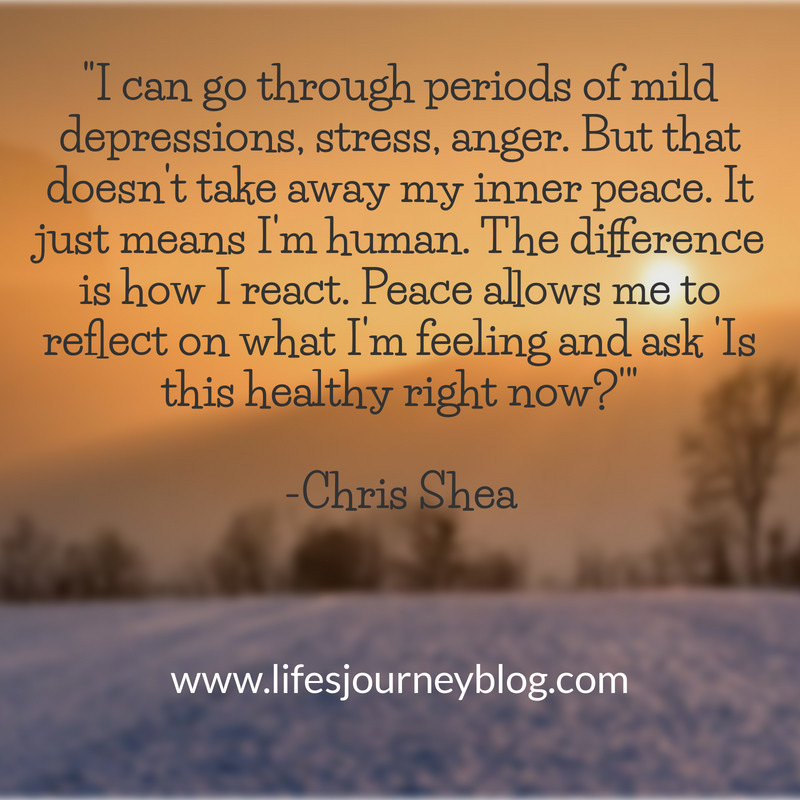
Chris Shea: Yes, I can act silly at times, and I can show my happiness and all of that with this sense of an inner peace, yet at the same time, I can go through periods of mild depressions, of stress, of anger. But that doesn’t take away an inner peace. That just means I’m human, and I’m reacting and responding to what’s going on in my life. I think the difference is how you do that. Am I intentionally responding? Am I aware of my response? Do I need to make changes? I think that peacefulness is that peace that allows me to reflect on what I’m feeling. I’m not just going off in anger, or off in depressions. I can consciously go into those feelings, act that way, and then begin to say to myself, “Is this healthy right now? Is this appropriate right now?” And then make changes if necessary. There is that intentionality, I think. Yes, I love that approach. I just think we need to be real. People will respond when they see you’re real.
Chris Shea: ‘Cause, if you go up on stage or go on a podcast like this, and you talk about these high ideals or seem to be having those high ideals, many people are gonna say, “I can’t do that.”
Chris Shea: But when they see that you’re real, I don’t think that takes away your ability to say, “Hey, I’m an expert in this,” or “I’ve got information to share.” I think actually people can come to you because, “Wait a minute, you’re real. You talked about all this, but I heard you get a little stressed over there,” or “Wasn’t that comment a little off in what you talk about?” And then you can say, “Well yeah, I’m human. Yeah. It is.”
Jan Bowen: Yeah.
Chris Shea: “But now, here’s what I’m gonna do about it.”
Jan Bowen: What do you do for fun?
Chris Shea: I love being out in the water, love being out in nature, love to read. Meteorology is a hobby of mine.
Chris Shea: Yeah, so there are outlets, and I encourage people to have outlets. But yeah for me, those are the things I’ve picked up over time, and that’s how I get out and have fun. There are some days or some evenings that I’ll say, “You know what? Forget the computer, forget my business stuff. I’m taking a hike, I’m going out on the water, I’m gonna read a nonsense book,” whatever it is. But I think that’s important to have those outlets so that there’s some diversity in your life, and you can relax.
Jan Bowen: In your words, what would you name as your top three values?
Chris Shea: The top three right off the top of my head would look at as being the most important would be honesty, and trust, and family. Those are all up there. Maybe not in that order, but those are the top three. But also looking at that, I would say … I don’t know if it’s necessarily a value, but it’s, “Can you be true to self?” And whatever that means for self. Again, you may not like who you are, or maybe you aren’t the best person at the moment, but can you at least be true to who you are, and be able to go from there? That’s something that I would value in another person, really respect in another person.
Jan Bowen: That’s wonderful. Is there anything that you’d like to say that I haven’t asked you?
Chris Shea: Know that it really is possible to find inner peace. Whether you believe that or not, it is possible. I’ve seen that in a lot of people, but I’ve seen it in myself, so I’m speaking from the experience. This isn’t just, “Hey, the theory says …” But no, I did it. People can do it. Just go with it, begin to believe in it, and yes, it’s possible.
{loadmoduleid 140}
How To Change My Perspective And Be Happy
Over the years I’ve come to the realization that my perspective is a point of life we don’t think of. Yet, perspective influences and dictates how I feel and act.
It’s all about my perspective! I feel that we are challenged to understand that the way we view or perceive the world around us is directly related to how we see ourselves. If I have low self-esteem or do not consider myself in a positive way, how can I view my relationships, work, and my community in any way but negative? Sure, I can fake it, and many people will believe the lie I tell them (and the lie I tell myself), but we know the truth.
During my undergraduate studies, I had a professor who was very knowledgeable in his field yet was quite miserable in his life. If you met him while you both were getting the morning coffee and were to say to him “good morning!”, his response would always be “don’t tell me what kind of morning to have!”
Bonus: Chris Shea is offering this free GIFT explaining how you can improve your life with life coaching! Click here to get it
In varying degrees, we’ve all felt similar to that professor. We can’t fathom a “good” morning or a beautiful day, or success. Why? Because we don’t feel it within us. We feel lost, unloved, anxious, that the world is against me. Those feelings are my perception, and that perception influences how we view our external world. My perception becomes, and indeed is, our reality.
Reality, philosophically and experientially, is not widely understood. I’ll stay away from a philosophical discussion of reality, except to reiterate that our experience of reality is based on our perceptions. None of us see or experience the world in precisely the same way as anyone else experiences it. Our existence, as it is experienced by each of us, at this moment, is based on how we feel about ourselves and what we have learned up to this moment.
All of our past experiences have taught us lessons. Every choice you made, with it’s resulting consequence, showed you to either make that choice again or to make a different decision in the future. Everything you was directly or indirectly told by family, friends, co-workers, colleagues, etc., have influenced you, coupled with your choices and experiences. Everything which has happened to you up until this moment has, in a significant way, affected who you are right now!
Therefore, in a real way, we are a product of our history. This is why I often say that the purpose of the past is to learn from it rather than dwell on it. Since we are products of our past decisions and actions, the theory is correct that if we don’t like who we are today, all we need to do is make different future choices and take different future actions. In other words, make a perspective shift.
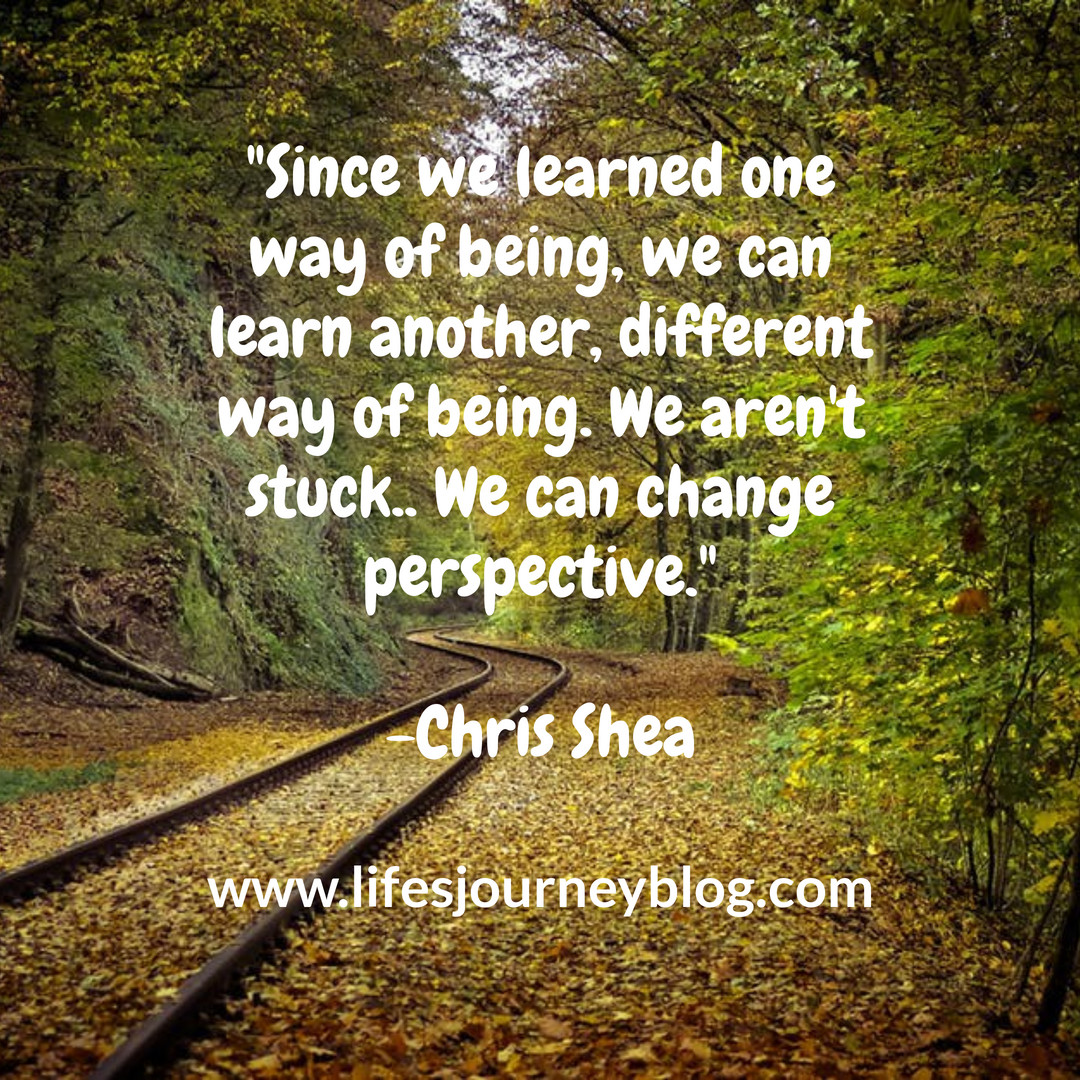
Since we learned one way of being, we can learn another, different way of being. We aren’t stuck. We can change perspective.
Through our experiences, we not only learned ways to act, but we also learned ways to think. If the experience was not emotionally pleasant, or an experience we want to forget, we learned what is called “distorted” thoughts, or “irrational” thoughts.
The reason we call specific thoughts distorted or irrational is that these thoughts do not deal with reality, nor do they lead us to happiness or inner peace. When traumatic experiences happen to us, our emotional response is to protect oneself. How we protect oneself is by skewing, in our mind, the reality of the event so that it becomes a “reality” we can cope with. In other words, it becomes my perspective. This new reality is different from the reality we are experiencing so that we can better deal with life. The coping mechanism itself is not harmful as it allows us to cope during the emotional experience, but if we continue to view our world in this skewed way we no longer interact with the world as it is, but as we perceive it to be, in my perspective. Therefore, we call these thoughts distorted or irrational thinking.
Identifying and understanding the origin of your distorted thinking allows you to reframe and change your thoughts to those which are healthy and will lead you to happiness and inner peace. We need to change perspective. Our life’s challenge is to stay focused on the present moment, non-judgementally, feeling what it is we are meant to feel at this moment, then making decisions which will lead us to a healthy way of coping with life; a perspective shift.
How do I know that I am coping healthily? Your thoughts and your actions will lead to resolution of your issues, and you will begin to feel inner freedom and peace for which you have longed. Then you will know that you are healthily coping with life.
{loadmodule mod_custom,continue the conversation here or on social media}
How To Feel Inner Peace By Changing Perspective
Inner peace is possible if we change our perspective to control what we can control. Peace of mind is in our thoughts and feelings.
Who doesn’t like to feel in control of life? Experiencing peace of mind is part of our human condition; believing that we have control over our lives. In actuality, we have limited control over life. How many times have you had plans for your day, only to have them changed by situations which were out of your control? Have you ever been in an accident? Was that in your control? How about the future; are you in control over situations which have not as yet happened? The source of peace is found in our ability to change our perspective.
As you can see, there is much about our life we have no control over, therefore the reason we don’t feel inner peace. This battle between wanting and believing we are in control, versus not being in control, is the primary cause of our stress. When reality enters our imaginary belief, we feel stressed. For many of us, when the fact of our lack of control becomes too much for us to handle, we mentally skew that reality, creating an imaginary reality in which we believe. This imaginary reality is not reality at all; merely our imagination. But, if we are convinced of our false reality, we may feel less stress, but we won’t feel at peace. Why? Feeling inner peace is about acceptance; creating an alternate reality is not acceptable at all, thus the importance of inner peace.
Bonus: Chris Shea is offering this free GIFT explaining how you can improve your life with life coaching! Click here to get it
Don’t go beating yourself up about skewing reality. We all do it. We’ve learned this behavior since we were children, regardless of how you were raised. In the realm of cognitive behavioral therapy, this way of thinking is called irrational. Not that we are irrational, but the idea of thinking about our reality in a skewed manner is irrational. In this setting, irrational is defined as leading us away from happiness. If a thought is such that leads us from being happy, doesn’t it make sense that it would be “irrational”? Why would we think opinions which don’t make us happy? Yet, we do it much of the time.
The ABC’s of irrational thoughts guide us in thinking rationally, that is, considering ideas which lead us to happiness and inner peace. The ABC’s reframe our perspective on life so that we think differently and therefore feel and act differently. In this construct, the “A” stands for the “activating event,” or, the event which has or is happening. The “B” is my belief about the event. The belief is my value judgment as to the goodness or badness of the event. The “C” is the consequence I am left with based on my value judgment. The “D” is my dispute with my irrational thought as a result of an adverse consequence. If I have a positive result, there is no reason for a dispute. Let me give you an example.
Let’s say a weather event happens, and it destroys your house. The “A” is the weather event. The “B” is your belief about the event, namely the destroyed house as a result of nature. The “C” is the consequence of how you are feeling as a result of your belief. If you believe that the house is but materials which can be replaced while the safety of your family matters most to you, then your consequence will be fairly positive so long as your family is truly safe. But, if you are upset and angry over losing your house to nature, and questioning why bad things always happen to you, then your “C” will be negative as those emotions are leading you away from your happiness.
In the example above, our stress increases while our inner peace decreases if, in our dispute (“D”), we try to change “A,” the event. In most situations, we have no control over the events of our lives. So when we dispute the events, we increase our stress as we realize our lack of control. But, what we do have control over are our thoughts and actions, the “B.” The key to coping with perceived negative situations is not to change the situation, but rather to change our belief about the situation. Instead of feeling that the world is out to get you and that is why nature destroyed your house, changing your belief to understanding the randomness of nature, and redirecting your frustrations to positive action for others, will change your consequence, the “C.” Your stress will decrease as you are changing what you have control to change!
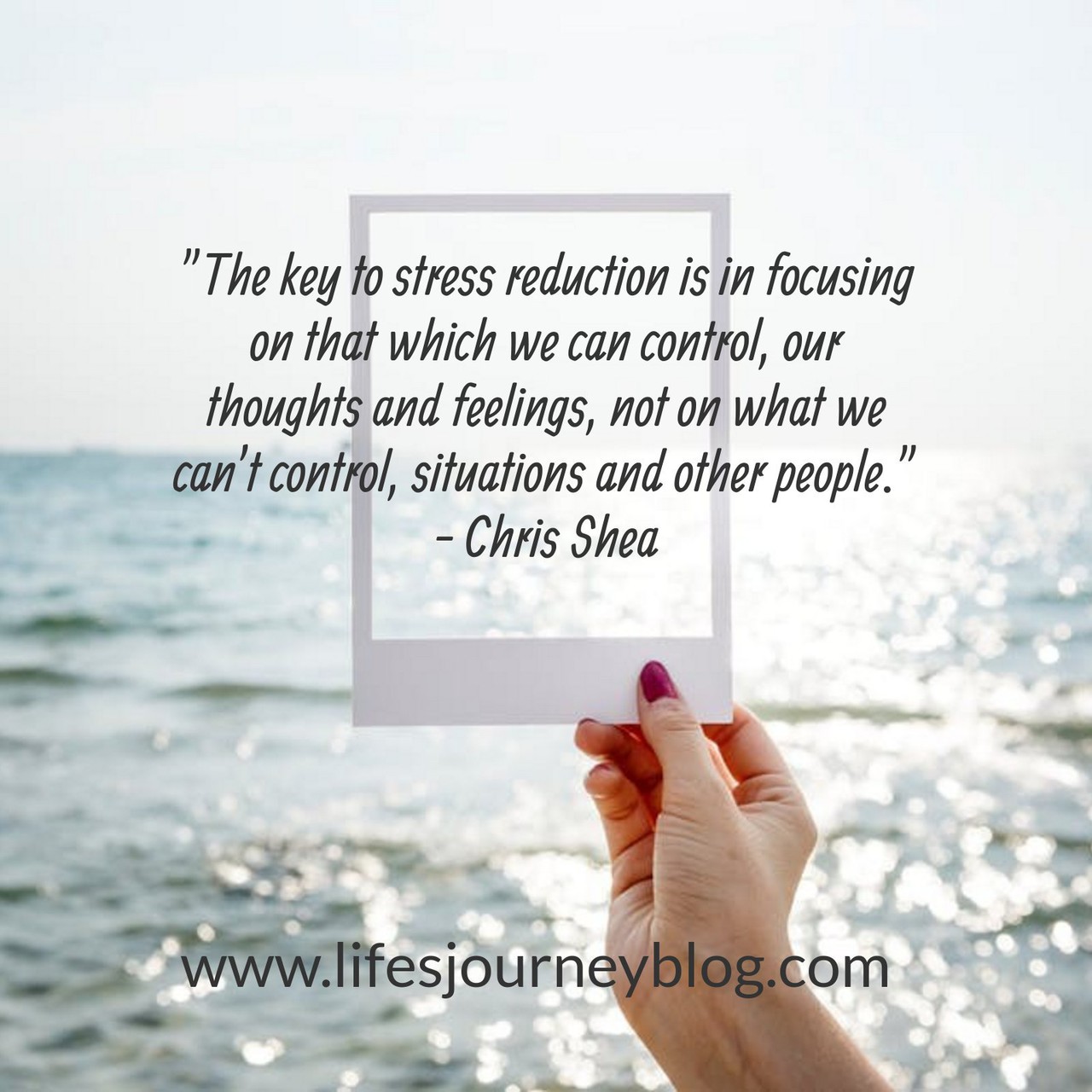
So, the key to stress reduction and the source of peace is in focusing our thoughts and actions on that which we can control, our thoughts and feelings, not on what we can’t control, namely situations and other people.
{loadmodule mod_custom,continue the conversation here or on social media}
How To Live An Awesome Stress And Anxiety Free Life Without Worry
Stress and anxiety are felt by us all. We can live a stress-free life and this article explains how.
“I am capable of thinking … yet I am not my thoughts; I am the thinker of my thoughts; therefore I can change what I feel and still be me”. -Terence Gorski
Each of us are responsible for our thoughts. Just as we create our thoughts, so also do we create our emotions and behaviors. Stress and anxiety are effected by our thoughts and behaviors. Our everyday stress can be eliminated once we believe that we can control our thoughts, therefore controlling our stress response.
When asking the question, “Who am I?”, we discover that a part of the answer lies within our thoughts, emotions, and actions. I often write and speak on this topic since the cause of anxiety and stress originates within ourselves, namely, within our thoughts.
Bonus: Chris Shea is offering this free GIFT explaining how you can improve your life with life coaching! Click here to get it
We tend to feel stress and anxiety over situations in which we believe we possess a lack of control. The opposite being true; if I believe that I have control over a situation my stress and anxiety will be lessened. In my work experience I have witnessed clients remain in an unhealthy situation, even when there are healthy alternatives, because their fear of the unknown stops them from making a change. The unknown can be a source of fear for in the unknown we have no control. A lack of control leads to increased anxiety, therefore, someone may remain in an unhealthy situation since they at least “know” that situation and so assume they have control over it.
We need to keep our thoughts focused on the present moment, for it is only in the present that we have the control to make changes. Focusing our thoughts on the past may cause anxiety and a stress response as we can’t control or change our past; we can only learn lessons from our past. Focusing our thoughts on the future may cause stress and anxiety as we can’t control what has not as yet happened. To maintain a stress free life we need to keep our thoughts focused on the present moment.
This is one of the reasons an examination of our thoughts, and the importance in believing that I have control over my thoughts, is vital to healthy living in a stress-free and lowered anxiety state.
As I see it, there is a difference between stress and anxiety. Stress can be eliminated from our life, while anxiety, to varying degrees, will always be with us. I teach that stress, being subjective to the perception of a person, is a person’s emotional (and at times physical) response to life situations. Hans Selye, a scientist, in 1936 defined stress as “the non-specific response of the body to any demand for change”. Notice the word “change” in the definition. Change, an unknown factor and therefore something out of my control, causes a stress response. Stress, as I see it, is our subjective response to a perceived lack of control. Since it is our response, and we are in control of our responses (behaviors and actions), we can eliminate our stress by changing our response (belief and action) to the situation.
Anxiety, on the other hand, is a pervasive sense of worry or unease, typically about the future. Whereas stress is our response to current situations in life, anxiety is an unease within ourselves regarding future events and outcomes. Stress tends to come and go given our situations at the moment; anxiety persists, to varying degrees, within us. Since anxiety is a response to unknown future events, anxiety (assuming one is not diagnosed with a severe anxiety disorder) leads us to take action. This action, in the form of preparing for the future, empowers us to tackle the unknown by taking control of things we actually have control over.
Anxiety is a component of our survival mechanism known as “fight or flight”. Anxiety is therefore a response in ourselves activated to help us survive by taking action! We will either physically or emotionally flee from, or stay to fight, whatever we perceive as a threat to our survival. This differs from stress which is our subjective response to a situation. Granted, mild stress may cause us to take action, but stress, as an emotion, is fickle as it comes and goes. Anxiety, mild most of the time, stays with us, vigilant in its mission of keeping us safe.
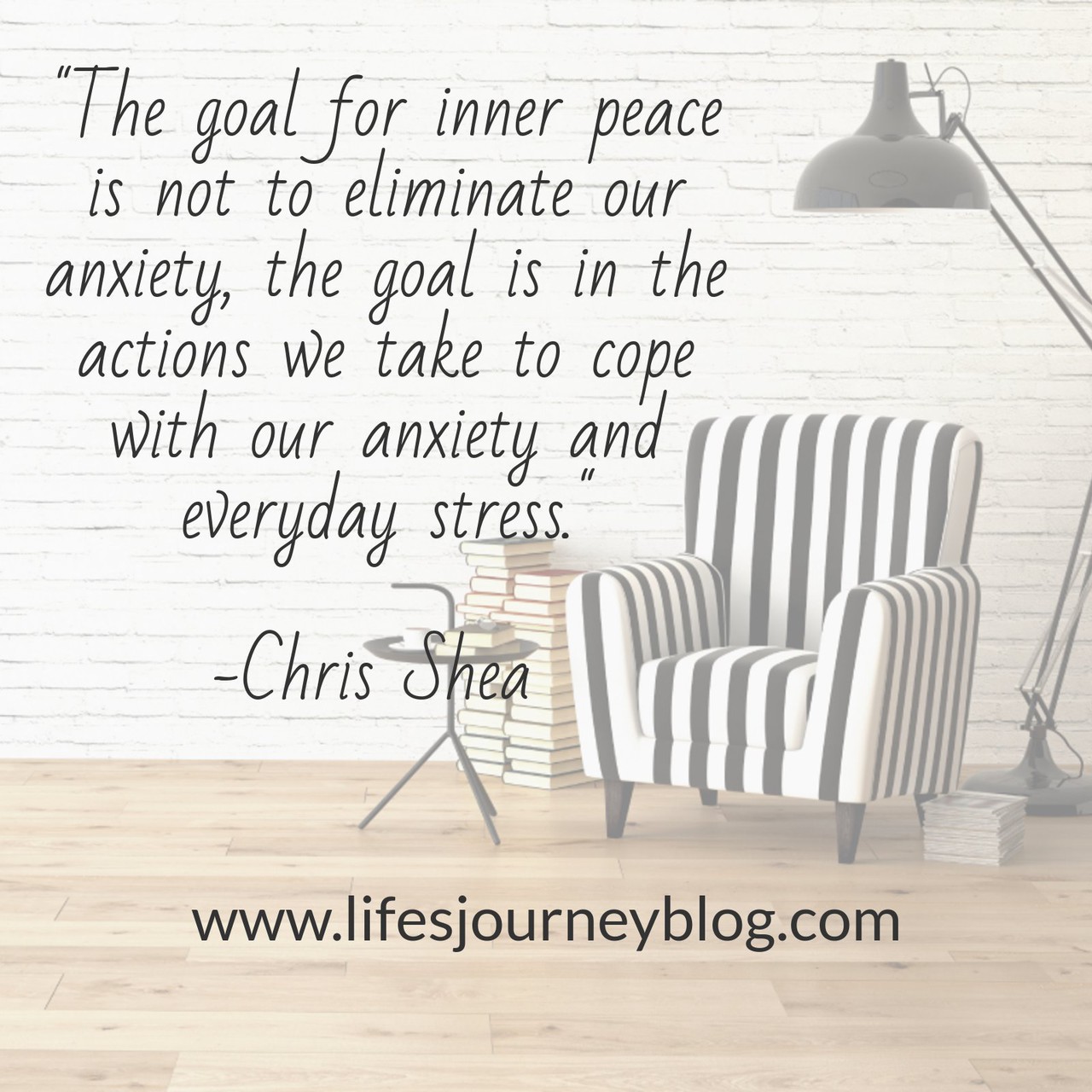
This is why, when I teach my clients about stress and anxiety, I teach them how to rid themselves of their stress, while reducing their anxiety. The goal for inner peace is not to eliminate our anxiety, the goal is in the actions we take to cope with our anxiety and everyday stress.
As I mentioned earlier, we can eliminate our stress by changing our response (belief and action) to the situation. How do we change our response? By changing our perception. The way we view the world is our perception, and our perception becomes our reality. This quote is quite powerful in its ability to succinctly explain the whole of what I’m trying to explain:
“We do not see the world as it is; we see the world as we are.” -Talmud
In other words, my perception of the world is directly related to my perception of self. Therefore, if I change my thoughts, feelings, and behaviors, as well as my view of myself, I will change how I see the world! This is why it’s important to reflect on our thoughts, believe that we can control those thoughts, and focus on eliminating stress.
{loadmodule mod_custom,continue the conversation here or on social media}
How To Make A Resolution A Positive Goal
“Plans are only good intentions unless they immediately degenerate into hard work.” – Peter Drucker
As the new year began many of us made resolutions for ourselves with healthy living intentions. We resolved to make our life better, to be healthier, to be successful, overall to be different from who we’ve been. But now, as the year progresses, we lament that many of our resolutions are not as accomplished as we hoped, and some we haven’t even started (or started yet now ended). What happened? What went wrong? Let me show you how to make a resolution.
As the Drucker quote states, our plans will not be successful, and we won’t reach our goal, if they don’t entail hard work. If we make resolutions which are too easy to accomplish we either put off for later, or just don’t fulfill us enough to continue with the task. If I may, I would like to expand on Drucker’s quote to include “plans which challenge and inspire us” we are more likely to stick with doing. The idea of hard work is important, but so are tasks which challenge and inspire.
Bonus: Chris Shea is offering this free GIFT explaining how you can improve your life with life coaching! Click here to get it
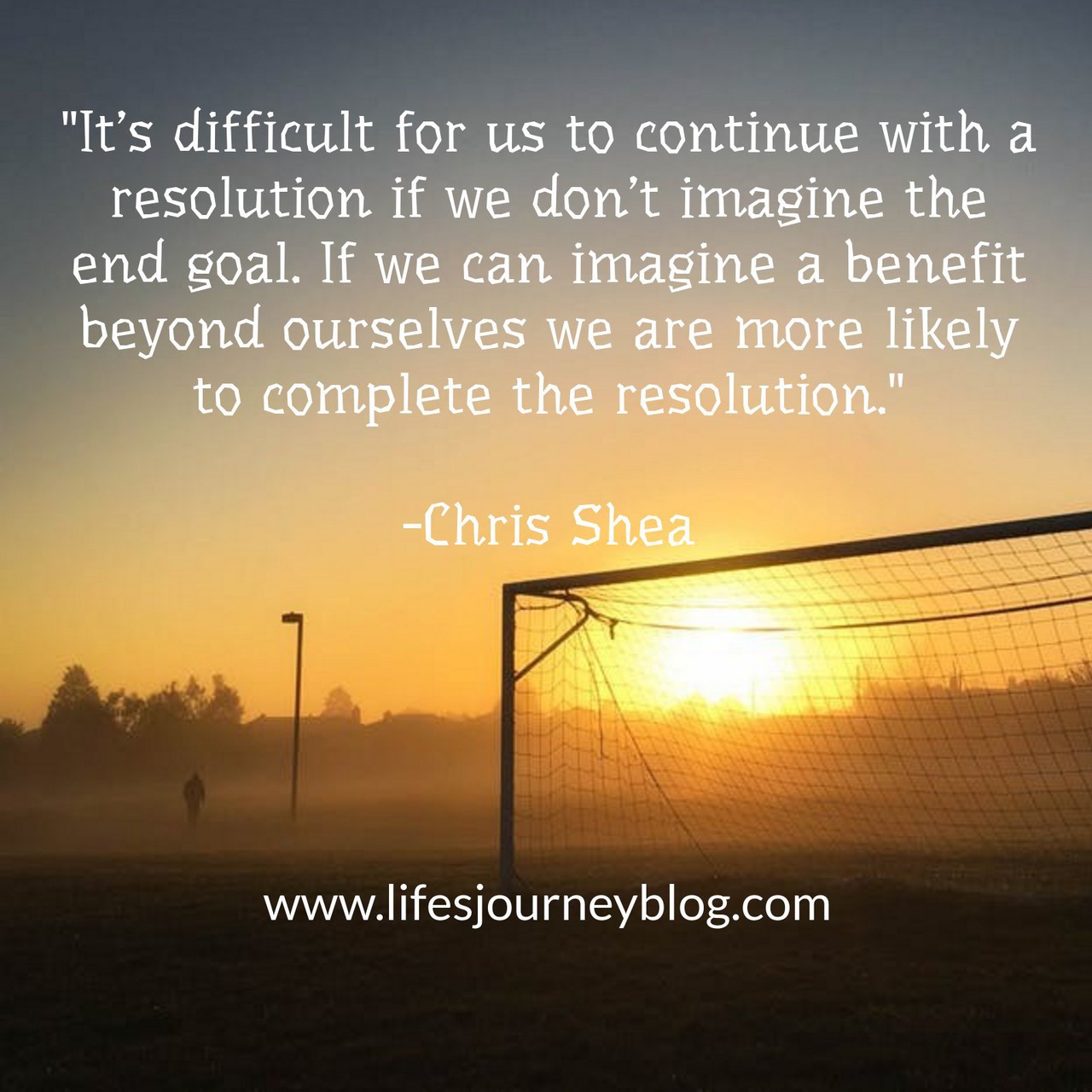
It’s difficult for us to continue with a task or make a resolution if we don’t imagine the end goal, and that goal not only challenges our abilities but also is inspirational. Meaning, in the wider scope of my life, what impact does this goal make on others. True, resolutions tend to be for our healthy living intentions, but if we can imagine a benefit beyond ourselves we are more likely to complete the resolution.
For example, if we make resolutions to eat healthier, and the goal is solely for my health, and even though the resolution may be challenging, and I am doing my best to actively eat healthier, the odds of this new task continuing, solely based on me being healthier, is slim. But, if I realize, and believe, that my new healthy diet will not only benefit myself but also my family and friends, then my motivation to be an example to others will make the odds of me sticking with my resolution higher.
One of the reasons self-help groups are effective is due to a community effort toward a shared goal. The members form a community of encouragement, understanding, action, and altruism. Each of these qualities are important, but it’s the altruistic nature of the members toward each other which encourages each member to continue in their resolve. If we view our resolutions in a similar way, we will be successful so long as we are altruistic.
Mindfulness, which is focused on living in the moment, is a beneficial foundation for creating our resolutions. Mindfulness teaches us that the past only exists in our minds. Reflecting on the past, when done non-judgmentally, allows us the opportunity to learn more about ourselves from our past experiences and choices. We can celebrate those moments when life was wonderful, and we can examine those moments when life didn’t go well to decide what we can do different now and in our planning for the future. In this way our past isn’t ignored but honored for what it teaches.
Making resolutions is a beneficial way for us to set goals for ourselves based on what we’ve learned from our past. Making these resolutions allows us to live in the moment as we take the time to figure out what it is we resolve to improve. Resolutions don’t need to be made only at the beginning of a new year.
One of the wonderful elements of living in the present moment is that we can “start over” whenever we need to. If my day is not going as planned and I find myself getting frustrated, I can stop, breathe, and start again. I don’t need to wait until the next morning, or even the next year to start over. I can start over any time I feel the need. Therefore, if you find yourself needing more time to work on your resolutions, take the time rather than rushing through a list because of a self-imposed obligation.
Here are my tips for how to make a resolution for healthy living intentions:
- Before creating your resolution list, take the time to reflect on your past. On a piece of paper (or e-device), make two columns, one column for what events went well; another column for those events that did not go well.
- Consider what you have learned from living through the events of both columns. What you feel you need to continue to learn, or to work on, is the beginning of your resolutions list.
- Ensure that any resolution you create is doable and realistic. Yes, we do need to challenge ourselves, but we don’t want to set ourselves up for failure, either.
- For each resolution, write out a “plan of action” listing the resources you will need to accomplish your goal. Make sure that before you start your resolution you have the needed resources necessary to attain your goal.
- Give each resolution a due date, to keep you on track. But, if you find that you are working the resolution yet need more time, be flexible with your schedule.
- And, this is my favorite, be compassionate with yourself! Yes, push yourself and challenge yourself; but if you are honestly doing your best to accomplish your goal, be compassionate during those times which are the toughest.
Make resolutions which will give you a new beginning. Challenge yourself while keeping your expectations reasonable. Then you will see changes in your life which will translate into inner peace.
{loadmodule mod_custom,continue the conversation here or on social media}
How To Be Caring With People Not Feeling The Holiday Joy
I don’t think there is any other time of the year which evokes such strong emotions as does this time of the year. For some of us we are excited, joyous, filled with wonder and anticipation! We visit family and friends, host parties and gatherings, spreading joy everywhere we go! But yet there are some of us who feel quite the opposite this time of the year. I think of those who recently lost a loved one, suffering from physical or mental health issues, separated from loved ones, and even estranged from family. There are those who past experience of the holidays wasn’t pleasant, and those who feel trapped in life situations.
“It’s the most wonderful time of the year!” While these song lyrics may be true for some, they’re not necessarily true for everyone. I’m not writing this to bring down the mood, for what I am saying is that we need to be mindful of people around us who may be suffering while we celebrate. Not all of my past holidays have been joyous, and I’m sure neither have yours. Some of my current clients are dreading these next few weeks, while other clients are looking forward to a new beginning!
Regardless of how we may feel about the holidays themselves, this time of the year finds many of us feeling the burden for perfection. As joyous as we may be, the expectations for a “Rockwell Christmas” haunt the best of us. While we still have our day-to-day tasks to complete we must also decorate, buy gifts, and attend social functions. These expectations, especially if we feel obligated, can cause stress and anxiety even in those who enjoy this time of the year. Now imagine the stress and anxiety felt by those who are simply trying to cope with life let alone the added expectation of the season.
This time of the year we tend to focus more of our attention on helping others and on giving back. Therefore, what can we do to either help or give to someone who is suffering during this holiday season?
- Create an awareness within yourself and your children that not everyone feels joyous this time of the year. This awareness is not meant to place a burden on us, but as a recognition for the reality of others.
- Create an environment where all people feel open to honestly share their feelings. While attending or planning parties and gatherings don’t simply encourage everyone to participate, be respectful of those who are having a difficult time participating. Try to plan activities which would allow for a person to participate to the degree in which they feel comfortable.
- Be mindful that your expectations of what makes up a holiday celebration may not be the expectations of others. Allow yourself the flexibility to be open to the traditions of others as well as to how others may be feeling. For example, if you are organising the family dinner, take into account any family members who have had a difficult year. Allow them the space or the time to speak, or not speak, if they wish. Be aware that their showing up may have been a difficult task in and of itself.
- If you know someone struggling to cope with a mental illness, or emotionally struggling, be a supportive friend. Allow time in your holiday schedule to be present to them even if words aren’t spoken. Never underestimate the positive effect and healing quality of presence. If possible and appropriate, encourage them to join you at small gatherings and surround them with people who have their best interest at heart. Isolation, especially during the holidays, is not healthy.
- Encourage them to do activities focused on taking care of themselves and their emotional health, regardless of the expectations placed upon them by self or others. Help them to understand that It doesn’t make you a selfish person when you prioritize yourself, it is actually essential toward your well-being.
- Take time from the busyness of this season to be an effective listener to those who wish to share their feelings. Encouraging and allowing others to share how they feel may be the most helpful thing you can do for them. Silence, especially for someone who is suffering emotionally, is not healthy this time of the year. If they are reluctant to share, lovingly encourage them by letting them know that you will listen without judgement regardless of what they wish to talk about and share.
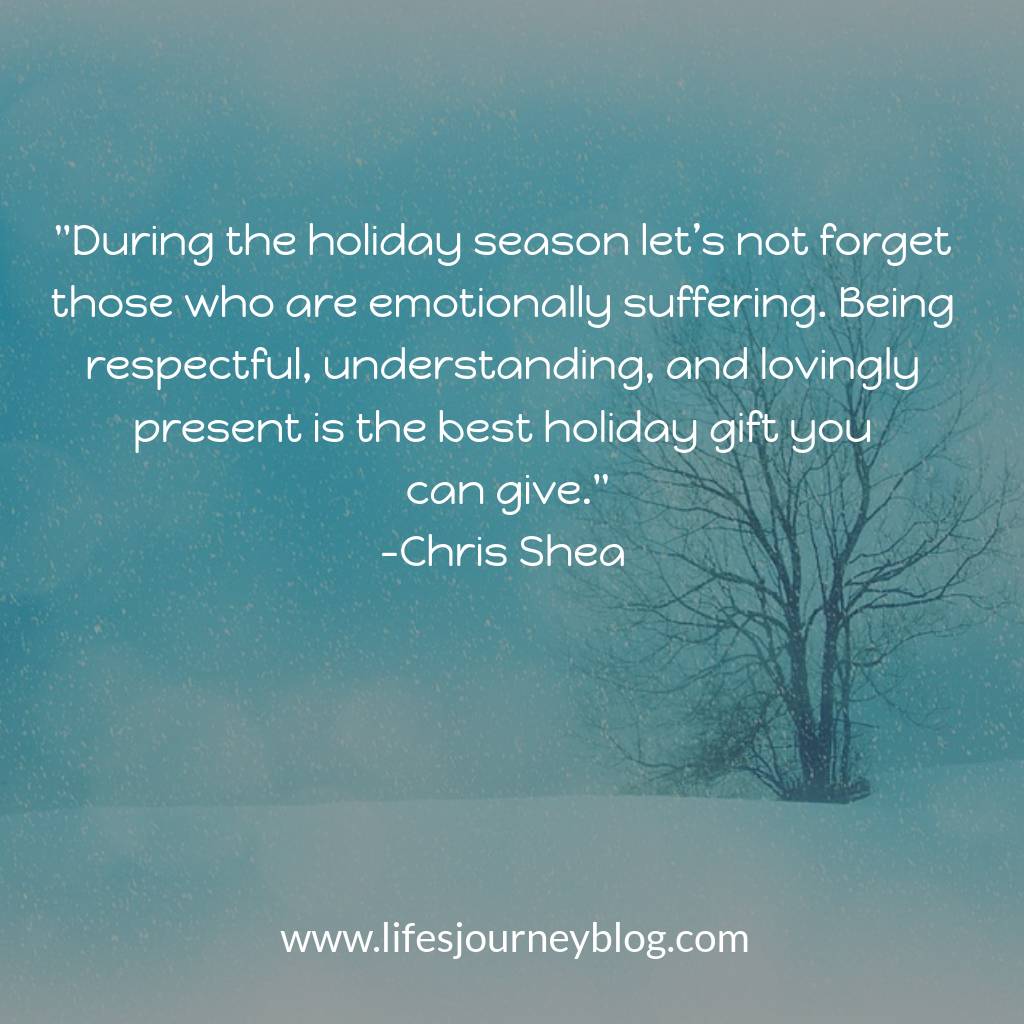
During this holiday season, as many of us join together with our families and friends, let’s be grateful and joyous in our traditions and fellowship. But let’s not forget those who are emotionally suffering at this time of the year. Being respectful, understanding, and lovingly present is the best holiday gift a person can receive.
{loadmodule mod_custom,continue the conversation here or on social media}
Have A Positive Life Through Mindful Imagination

As I’ve grown older I realize that I’m not as creative as I was as a child. Whether that’s actually true or just my perception, it’s my current reality. Children have a sense of wonder about them, partly because many of their life experiences are new to them. I watch the reaction on the face of my granddaughter, not yet a year old, and I see the wonder and amazement as she experiences the word around her for the first time. I don’t remember ever being that age, but I do remember that as a child my imagination and creativity were awesome!
As children, we imagine ourselves as being any occupation, and even some made up super human people saving the world. Our desire to experience the world in all its fullness, and add to it, seem to wane in many of us as we age. I think the education system is partly to blame, but, realistically, I blame the economy. Why? Most of us need to find employment to survive, and many of the jobs are routine and mundane. Rare are those who gain employment wherein imagination is necessary. The rest of us simply live out our lives, as happy and content as possible. Yet lacking in imagination.
Imagination guides us toward our hopes, keeping us enthused and passionate about life. Imagination leads to discovery and understanding. Imagination, when grounded in reality and sprinkled with an appropriate amount of dreams, guides us along the path of possibilities. Imagination is what separates us as humans from the rest of the animal world. We have the ability to think and feel beyond and outside of our reality. We have formed societies on the imagination of national borders, religions, and money; none of which exist but for our imagination. We place importance and value on gold rocks and shiny gems, but the reality is that their value only lies in our imagination. How is this any different from a child placing value on a random object?
Bonus: Chris Shea is offering this free GIFT explaining how you can improve your life with life coaching! Click here to get it
Mindfulness, focusing one’s awareness on the present moment, while calmly acknowledging and accepting one’s feelings, thoughts, and bodily sensations, enables us to be rooted in the present moment. Children live in the present moment, focused on what they now feel and in what they are now doing. In a positive way, we can learn from the example of the child who is so focused on the present that they notice the wonders of the world which pass us by in our hurried lives. What child doesn’t stop to watch the ant or to play with the spider, all the while the adult is yelling at them for taking too long to get something done.
In that moment when the child is watching the bug they are also imagining what that bug’s life is like. Where does it live, does it have a family, is it playing or working? The child uses their imagination to learn more deeply about the world around them. Do we?
Understanding and believing that my current reality does not always need to be my reality, imagination blossoms into hope. Mindfulness allows us the understanding that we can’t change our past, but we can learn from the past to help us prepare for the future. Our current reality, our current situation in life, does not need to be our reality in the future. The only way that I’m going to see a different future is to imagine a different reality. My imagination is capable of becoming my reality.
Who I am has a lot to do with my imagination. Ask yourself these questions:
- As a child, how did I imagine myself and my world?
- As an adult, how have those images and dreams changed?
- What are the common themes?
- What, practically, can I do to make my dreams a reality?
Don’t let adulthood stop you from imagining, dreaming, or having a sense of wonder! Experience your reality in all of it’s wonderment, and imagine a future of hope, possibilities, and peace! Children do.
{loadmodule mod_custom,continue the conversation here or on social media}
Finding True Gratitude Through Mindfulness And Action
For as long as I can remember, November is a special month for me. Why? Well, autumn is in full swing and the holiday season is just around the corner! November is also a special month for me since it’s a time which inspires gratitude. During this month many of us take time from our busy lives to reflect on what, and whom, we are grateful.
The dictionary defines gratitude as “the quality of being thankful”. We recognize that in our lives there are things for which we are grateful, regardless of our life’s’ circumstance. If we look hard enough, we will find something, at least that’s what I’ve been told. A platitude to be sure, although in this platitude we find wisdom. Namely, if my perspective and goal is to find something for which to be thankful, I will find it. The opposite is true; the more I focus my perspective on the negatives in life the greater the belief that my life is completely negative.
Simply being thankful, or grateful, for the sake of being grateful, is not always altruistic. Can our sense of gratitude also be self-serving? Might it be a mask for our own narcissistic consumerism? Think of what you are grateful for, noting how many items are materialistic goods versus people or talents. A review of social media postings on gratitude overemphasize goods, money, prestige, etc. Isn’t it possible that our gratitude could reinforce our desire for what we think brings happiness? Have you noticed the irony, that the very next day (or even that same evening) after we celebrate being thankful, we celebrate shopping, materialism, greed, and rudeness! Gratitude alone, as the end goal, leads to self-centeredness.
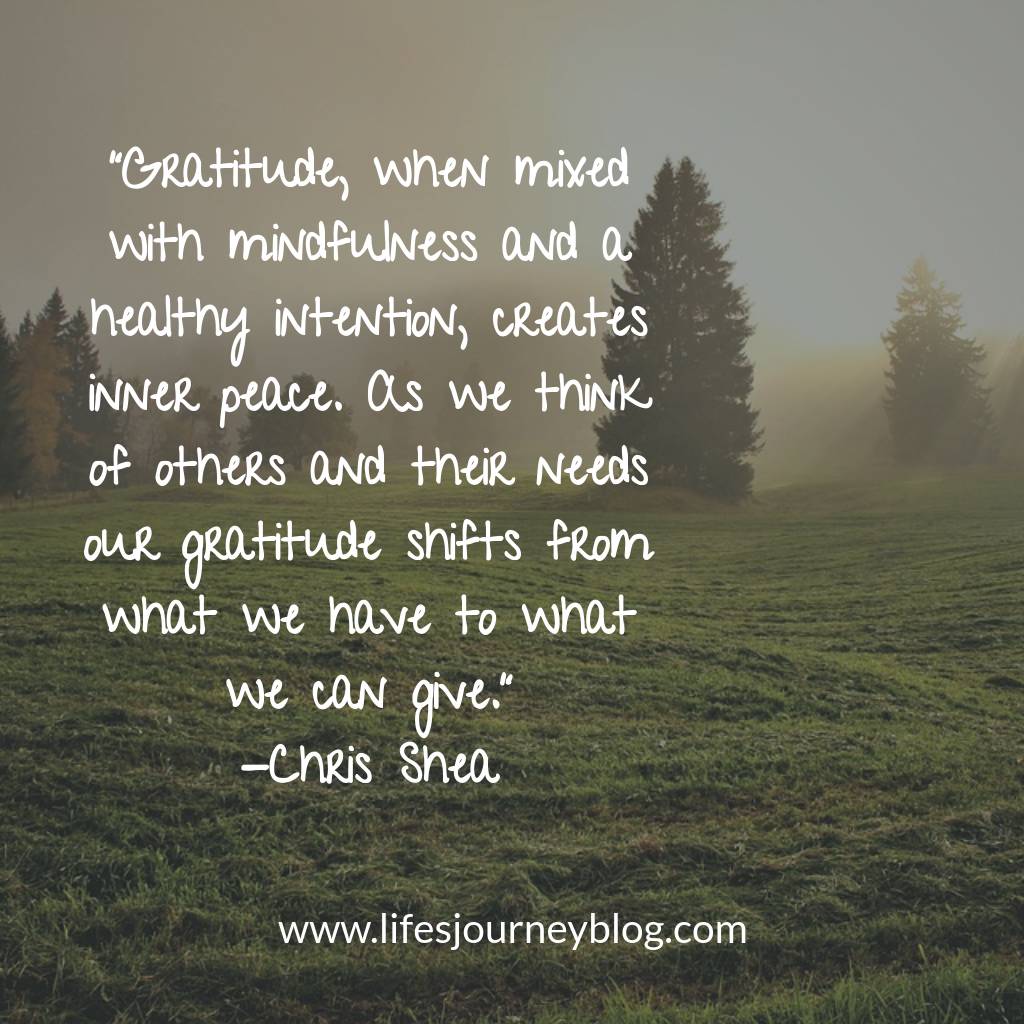
Am I saying we shouldn’t be grateful? Not at all! Gratitude, when mixed with mindfulness and a healthy intention, leads us to a sense of inner peace. If my intention is to be grateful because it looks good, is what everyone else is doing on social media, it will show people all that I have, etc, then I become self-centered. Yet, if my intention is to be grateful for the sake of being thankful with a readiness to show appreciation, then I will find my inner peace and happiness. Why? Because being grateful is not the end goal, rather, gratitude is the beginning of the process of giving back.
The dictionary further defines gratitude as a “readiness to show appreciation for and to return kindness”. The key of this definition is the phrase “…and to return kindness”. The intention and end goal is no longer self, but the action of giving back to others that which we have received. As we think of others and their needs our gratitude shifts from what we have to what we can give to others.
Mindfulness is commonly defined as “a means of paying attention in a particular way; on purpose, in the present moment, and nonjudgmentally.” The practice of mindfulness coupled with an attitude of gratitude focus us on the present with an appreciation for what we have now, rather than wanting more and more. Maintaining a focus on an appreciation in the present moment protects us from the evils of greed which will turn us away from our inner peace. Gratitude for what we have at this moment, mixed with a desire to return kindness to others, is a healthy sense of gratitude creating in us a deeper sense of self and peace.
True gratitude practiced mindfully reveals a connectedness. Being thankful connects us to those who have given us the reason to be thankful while at the same time inspiring us to be gift-givers. In this sense our well-being and the well-being of others are connected. We begin to understand more fully how social connections impact us. Spreading gratitude to others creates gratitude in the other. The cycle is repeated when that person in turn spreads their newfound gratitude on to others. Gratitude, as with hate, spreads rapidly throughout societies. If we examine that first Thanksgiving in colonial America we discover that the gratitude and thankfulness celebrated was not in the food shared, but in the connectedness of the people present.
Therefore, our challenge is to mindfully reflect on what it is that makes us grateful. In so doing let us not fail to recognize the people outside of ourselves. Acknowledging gratitude for our material goods and the gifts that we have is not sufficient. We need to also acknowledge gratitude for the people whom we know, and those unknown to us, who enable us to have and to be who we are at this the present moment.
During this holiday season, as you gather with family and friends, acknowledge, in gratitude, those family members who have made it possible for you to be the person you are. For better or for worse we are the products of our history embedded within a society and a family who have made possible our lifestyle. By reflecting in this way we remain outside of ourselves while embracing our connectedness. When our thankfulness becomes compassion and compassion leads to action, then true gratitude is realized.
{loadmodule mod_custom,continue the conversation here or on social media}
5 Reasons Why Mindfulness Matters
If I were to ask you “what ultimately do you want from life?”, many of you would answer “to be happy”; “to have money”; “to have success”; etc. We seek answers from life, while our culture answers with “get more stuff and gain fame then you will feel happy”. Will this suffice as your answer to your life question? Is that really what you want, or is there something else, something deeper for which you long?
During my time as a counselor I have worked with clients from every socio-economic status. Regardless of money or available material resources, everyone was seeking a common answer, namely, how to get a deep feeling of peace. As a result of their life struggles they came to realize that material goods and wealth is fleeting and can be lost. Therefore, they could no longer find satisfaction in material goods.
What makes me different from other life coaches is that I’m not promising you your dreams. I work in leading you to find inner peace, resulting in a self love expressed in action. My goal is not to make you successful, rich, or famous. I don’t care if you succeed or fail in aspects of your life. My goal is for you to find inner peace despite what is happening in your life. The key is found in your priorities and your perception.
The way to find our peace is through the daily practice of mindfulness. Why does the practice of mindfulness matter? A bit over 5 years ago I made a significant job change which “forced” me, as a type A person, to slow down. At the time I wasn’t yet consciously aware that I was beginning to live mindfully. As I slowed myself internally and externally, I focused my thoughts and attention on the present moment. No longer was I dwelling on my past nor anxious about my future. This was quite the change for me as I used to be the king of anxiety and worry!
It was during this time I’m my life when I discovered Jon Kabat-Zinn’s definition of mindfulness: “a means of paying attention in a particular way; on purpose, in the present moment, and nonjudgmentally.” Personally, the two key phrases in this definition which are important to me are “on purpose” and “nonjudgmentally”. To find inner-peace we need to consciously make the choice to spend time every day focusing our attention on what is happening around and within us. Our focus is not meant to judge what is happening, just to notice it, to experience it. As we become aware of our surroundings and inner self, we become aware of life’s joys, sorrows, difficulties, potential, and hope. In this state of focused awareness we are enabled to discover solutions. This is why mindfulness matters.
In the past five years or so there have been significant studies conducted by reputable organizations such as Harvard on the effectiveness of mindfulness. The results, without dispute, show that mindfulness and meditation not only make us feel better, but can physically heal the body and grow gray matter in the brain. Mindfulness is not simply a nice thing to do, science is proving that it actually heals the body and mind.
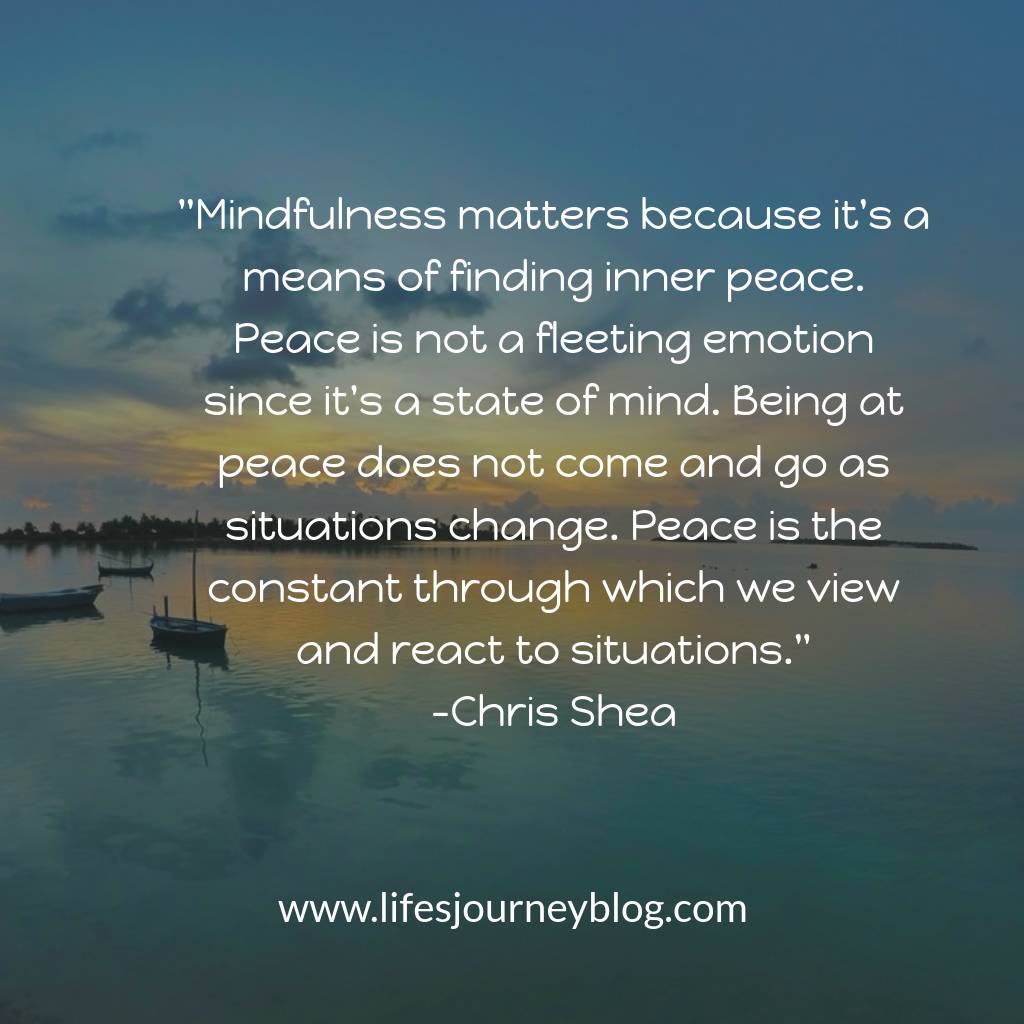
Mindfulness matters because it’s a means of finding inner peace. Instead of seeking just satisfaction in life, seek peace. Peace is not a fleeting emotion since it’s a state of mind and being. Being at peace does not come and go as the situations change. Peace is the constant through which we view and react to situations. For example, I can feel sad and remain in a state of peace, but I can’t feel both happy and sad at the same time. Therefore, striving for peace leads us deeper into ourselves.
The belief that we don’t have control over our lives leads us away from inner peace. The more that I feel out of control in my life the greater my anxiety. When you understand, and believe, that you do have control over your thoughts and feelings, then you admit that you do have some control over your life! Since you have control you are no longer helpless! We may not have control over our situations, but we do have control, always, in how we respond to our situations. How I perceive the situation and what action I take influences how deeply my inner peace is being rooted.
As I personally continue to learn about and experience mindfulness, I have come up with this list of my 5 reasons why mindfulness matters.
- Mindfulness keeps us focused in the present moment, the here and now. Why is this important? We have no control over the past or the present, so we feel anxious. But, we do have control over how we respond to the present moment. Keeping our thoughts on the present is empowering.
- Mindfulness changes my perception on learned helplessness. Many times, if we’ve suffered from trauma, we tell ourselves that we are now, and always will be, helpless to avoid negative impacts in our life. By working on number one above we can change our thoughts from those of helplessness to those of solutions. Remember, anything we’ve learned can be unlearned or learned differently.
- Mindfulness keeps us from getting discouraged. We become discouraged when our expectations aren’t met. Was the expectation reasonable? Did you have control over the outcome? Mindfulness, by focusing on the present, helps us keep our expectations reasonable, and as mentioned in number 2, guides us in understanding what is and is not in our control.
- Mindfulness changes our perspective. This is an essential reason why mindfulness matters! Perspective, the way we view and so respond to our world, is sometimes skewed because of past trauma, unpleasant situations, past hurts, etc. Using mindful meditation to focus ourselves on the present, and so on how we feel, will guide us to refocus our perspective, therefore responding in a more healthy way to our situation.
- Mindfulness calms our anxiety. I mention this one last on purpose. If you can accomplish 1-4 above, the natural result, or consequence, will be reduced anxiety. By focusing on the present moment, we understand what is and is not in our control, allowing us to no longer feel helpless and so change our perspective.
Mindfulness matters to each of us in our daily lives. I know from experience the change that mindfulness can have on a person, and I desire for you to have a similar (yet your own) experience with mindfulness. Start slow by meditating 10 minutes a day and consciously refocusing your thoughts on the present moment. Over time, increase your meditation duration and do more mindfulness exercises. You’ve got this!
{loadmodule mod_custom,continue the conversation here or on social media}
How To Cultivate Self Love
To cultivate self love is such an important aspect for our health yet many of us either don’t think of loving ourselves or feel that we are unworthy of self love. To love is not an easy task yet we find it much easier to love others then to love ourselves. Why is this? I believe it’s because we know ourselves too well that we find it difficult to cultivate self love.
The idea of loving humanity is easy to grasp since we don’t have a personal relationship with all of humanity. I can feel a sense of love for the poor or those affected by natural disasters, because I don’t know them and therefore don’t know their flaws. Once we know a person’s flaws we judge them to decide who is worthy of our love and who is not.
Since we are aware of our own flaws many of us have judged ourselves unworthy of our love. We may even feel uncomfortable when others express their love for us, but we can let that go since we understand that they do not know us as well as we know ourselves. We may even tell ourselves that if they did know us as we know ourselves they would never express a desire to love us.
Yet, if we are seeking to find our inner peace, or at least a sense of happiness in life, it is vital that we learn to love ourselves. Not only do we get in the way of ourselves, modern society does not mirror for us what a healthy self love is. Much of society relies on a notion of love based on what we have, or who we have, or on our wants and desires. A healthy self love is focused on growth, caring, and an enduring desire to be the best person that one can be.
When I speak of cultivating self-love I am not speaking of love as a theoretical concept, but an understanding of love as a true belief. In order to find happiness and inner peace we need to honestly believe that we are not only worthy of self love but that we actually do love ourselves. Self love is focused on who we truly are, accepting ourselves for all the good and all the areas in which we need to grow. Unconditional self love accepts our flaws, guiding us to constantly seek personal growth and Improvement. We do not see our flaws as a hindrance to our growth but as the impetus to strive to be the best person we can be.
To cultivate self-love is a process which takes time, but in the end the results are amazing! Here are 10 things I suggest to my clients that they do, on a daily basis, to help cultivate self love and grow into a true feeling of inner peace:
- Practice mindfulness. What I mean by mindfulness is that we focus our thoughts on the present moment allowing ourselves to fully experience what we see and feel in each moment of our life. Mindfulness is a way to slow ourselves so that we can appreciate the little things in life which can pass us by. It is through this process of slowing down that we can more fully understand who we are, our place in the world, and what we need to do to grow in a healthy emotional and mental state.
- As we reflect on ourselves we begin to differentiate between our wants and our needs. Too much focus on our wants prevents us from finding inner peace since we will never achieve or accumulate all of our continuous wants. Focusing on our needs, and finding creative ways to satisfy those needs, leads us to inner peace for we become fulfilled and empowered through our achievements.
- Forgiveness is an important aspect of love since we can’t love another and not ever have the need to forgive them. Just as we would forgive another for something they have done, we also need to forgive ourselves for all that we have done. Forgiveness, freely given, frees us to move on knowing that the wrong we have done no longer weighs us down. None of us are immune to doing things which will need to be forgiven, that’s part of being human. The issue is not in doing things which require forgiveness, the issue is in what we learn from what we have done. It is not productive to focus on our flaws but it is productive to compassionately forgive ourselves, learn from our wrongs, and so grow in wisdom.
- The main difference between a victim and a survivor is that the survivor has created options and is taking action. As we strive to cultivate self love we need to take action steps in making the changes in our lives which allow us to grow. As has been said, love is an action not a noun. Determine what actions you need to take, moving forward to making those actions a reality.
- One of the ways in which we can grow is in challenging ourselves to accomplish things which we never felt were achievable. I’m not suggesting that we all need to climb Mount Everest, but I am suggesting that all of us find those aspects of our lives which we feel challenged by and rise to that challenge. The wisdom and the knowledge gained as we reach new heights will empower us to feel worthy of loving ourselves.
- In helping others we help ourselves. There is a lot of truth in this statement for when we challenge ourselves to give of ourselves for another we gain a deeper sense of what love in action is all about. The help and love that we give to others is returned to us. This is not simply a cute statement but a reality which I have found lived in my own experience. If you want to love yourself you need to find the strength to love and help others to love themselves.
- Letting go of what we can’t control in life leads us to a deeper sense of peace and self-love. Changing those areas of our life in which we have control to change enables us to grow, while letting go of those things which we can’t control relieves our stress and anxiety as we no longer struggle with what we will never accomplish.
- Focus your action steps on reasonable expectations and outcomes. The feeling of stress and anxiety keeps us from feeling peace and self-love. Having unreasonable expectations which are never met not only increases our anxiety but can teach us that we are worthless as we can’t seem to accomplish or reach our expectations. Yet the reason we cannot achieve those expectations has nothing to do with self-worth but has everything to do with unreasonable expectations. Practice placing reasonable expectations and you will find the outcomes will follow.
- I am pleased to see many recent articles talking about the need and importance for simplifying one’s life. As we gather more material goods and keep ourselves busy to make it look good for others we find that we are more stressful and anxious than ever. It’s reasonable to think that the more we simplify our life, downsize, get rid of material possessions, and be active in those areas which are important to our growth, will reduce our anxiety and open us up to be receptive of the self-love and inner peace we desire.
- Be passionate about all you do and you will receive much joy and satisfaction from life. Whether it be your job, family, or hobbies being passionate about life will make you feel more worthy of the self love which you desire.
To cultivate self love is a process involving many aspects of our lives. We must truly believe that we are worthy of self love and take action in helping others. Mirror that love which we so desire in our own life. In the way that we love other people, are compassionate, and forgiving, so too we need to be all of those things for ourselves. Treat yourself as you treat others and you will find self love and inner peace.
{loadmodule mod_custom,continue the conversation here or on social media}