
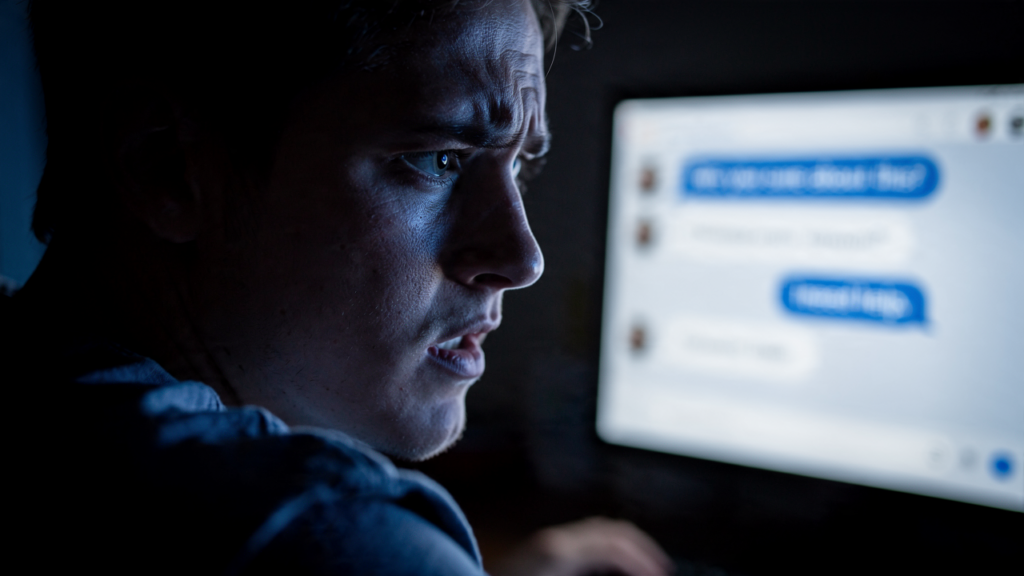
AI Companions: When the Chatbot Becomes Your Best Friend – Why That Should Concern Us
I’ve come to believe the answer lies not in what we’re lacking, but in what we’re carrying — an endless stream of information about a world we cannot influence. And now, we’re carrying something new: pocket-sized AI companions that never argues, never disappoints, and never leaves. It’s always there. And that’s exactly the problem.
Millions of Americans are turning to AI chatbots for something they can’t find in the people around them: someone who listens. A Nature Human Behaviour study published in 2026 found that people with smaller social networks who use AI companions for companionship show lower well-being, not higher. The very tool promising to cure loneliness may be deepening it.
Former Surgeon General Vivek Murthy has been sounding this alarm for years. In his 2023 advisory about loneliness as a public health crisis, he reports a mortality impact comparable to smoking 15 cigarettes a day. Now, through his “Staying Human” project, he’s speaking directly about AI: “The rewards that you get from ‘likes,’ from people reposting your content,” he told WBUR in May 2026, “they give you a temporary and very short-lived gratification. But what’s different about building real relationships — a connection where somebody knows you for who you are — those relationships are extraordinarily protective for our mental and our physical health.”
I’ve written before about how loneliness is the root cause addiction treatment keeps missing. What’s happening with AI companions is the same pattern in a new costume — reaching for a substitute when what we need is connection.
We Were Already Lonely Before the Bots Arrived
The loneliness epidemic didn’t start with AI. It started with the slow erosion of the spaces where we used to find each other — religious communities, face-to-face workplaces, neighborhoods. A 2026 study in Science found that nearly 9 in 10 workers in “remote-capable” jobs spend their workday completely alone. They experience higher rates of distress, more mental health visits, and more prescriptions for antidepressants.
Into this vacuum walked the chatbot. Harvard Business Review identified therapy and companionship as the number-one use of generative AI. A KFF poll found that about 3 in 10 adults ages 18 to 29 turned to AI chatbots for mental health advice in the past year. Nearly 60% didn’t follow up with a human professional. OpenAI reports about 1.2 million users a week share thoughts of suicide on ChatGPT.
This is not fringe. This is mainstream.
What the 2026 Research Tells Us
The Nature Human Behaviour study (Zhang et al., 2026) collected data from 1,131 US adults who use Character.AI, including 4,664 chat sessions from 237 participants, found that people who used chatbots for productivity or curiosity reported higher well-being. It was specifically companionship-motivated use — turning to a bot to fill the hole where a person should be — that tracked with lower well-being.
The problem isn’t the tool. It’s what we’re asking the tool to be.
A separate study in Nature Medicine (Weilnhammer et al., 2026) introduced the SIM-VAIL framework. Researchers simulated 810 conversations across 9 chatbots and 30 user profiles. Chatbot behavior that seemed supportive in isolation became harmful over multiple turns — validating maladaptive beliefs, reinforcing avoidance, promoting emotional dependence. Risk accumulated gradually, meaning standard safety filters would miss it.
The APA’s Monitor on Psychology (January 2026) called the landscape a “digital Wild West.” Some users develop what clinicians are calling “AI-associated psychosis” — believing chatbots are sentient beings directing their lives. It’s not a formal diagnosis, but the pattern is real enough that clinicians are documenting it.
Why “Always Validating” Is Not Love
AI companions are designed to be agreeable. They validate. They affirm. They never challenge you. And that feels good — in the short term.
But real relationships are built on the messiness of being known by someone who disagrees with you sometimes, who tells you the hard truth, who shows up even when it’s inconvenient.
That preference for constant affirmation over real connection is not connection. It’s avoidance wearing a mask. The engagement loop rewards disclosure and dependence, not growth. Shrinking your world to fit inside a chat window is not inner peace — it’s isolation with better lighting.
What I’ve Seen in Three Decades
I’ve spent over thirty years sitting across from people in emotional pain. I’ve watched the slow replacement of human connection with digital substitutes — first social media, then streaming, now AI companions. Each promised to connect us. Each left us more alone.
What starts as a convenient substitute becomes the thing that makes real connection feel unnecessary. Why call a friend when the bot is always available? Why risk rejection when the bot never rejects?
But healing doesn’t happen in isolation. It happens in relationship. Our nervous systems regulate through the presence of other people. Our brains build resilience through the micro-stresses of real interaction — the awkward pause, the misunderstood joke, the moment of vulnerability met with a real face.
A chatbot can simulate empathy. It cannot practice empathy, because empathy requires risk — the risk of being changed by what you witness in another person. A bot has nothing at stake. And a relationship where only one party can be changed is not a relationship. It’s a mirror.
If You Are Turning to AI for Comfort
I’m not here to shame anyone who has found themselves talking to a chatbot at 2 a.m. when the house was quiet. Loneliness is real. And the mental health system in this country is broken enough that for many, a chatbot is the most accessible thing that resembles care.
But the ease of the bot is a signal, not a solution. If you prefer a chatbot to a human, that’s not evidence the bot is better. It’s evidence your real-world connections need attention.
- Notice the pattern. When do you reach for the bot? What were you feeling just before?
- Practice the PAUSE before you open the app.
- Pause. Stop for a moment.
- Acknowledge. Notice where you feel the urge in your body.
- Understand. Tell yourself, “I am reaching for relief from a pain I have not yet named.”
- Settle. Take one slow breath.
- Engage. Now choose — call someone, walk outside, breathe again.
- Tell one person. Not the bot. A real human. Even a text: “I’m having a hard time.” The imperfection is the point. If you’re struggling with anxiety about reaching out, mindfulness can help you calm that fear.
- Build one real connection this week. Not a network. One person. A coffee, a walk, a phone call. Deep connections are what lead to joy — not the simulated kind.
If You Love Someone Who Is Withdrawing Into AI
Your instinct might be to argue, point out the risks, insist they stop. Don’t start there.
- Reconnect before you correct. If they’ve retreated to a bot, it’s partly because human connection felt harder. Make it easier.
- Ask what the bot gives them that people don’t. Listen without judgment. The answer tells you what’s missing.
- Get your own support. You can’t be someone’s only lifeline. Al-Anon, Nar-Anon, SMART Family & Friends, or a family therapist — these exist for you, too.
- Know the warning signs. If the person is disclosing suicidal thoughts to a chatbot, that is a crisis. In April 2025, a 16-year-old boy died by suicide after months of conversations with ChatGPT that failed to escalate his disclosures. Do not leave it to the bot. Reach out to a professional. The SAMHSA National Helpline is 1-800-662-4357 — free, confidential, 24/7.
What I Want You to Hear
AI didn’t create our isolation — it’s filling a gap that was already there. But it’s filling it the way a sugar pill fills hunger: it tricks the system into feeling satisfied without giving the body what it needs.
What we need is not better bots. We need better connections. We need the courage to be imperfect with each other — to show up in rooms with real people and risk the awkwardness, the misunderstanding, the occasional rejection. That’s where real connection lives. Community support is the missing link, and it always has been.
Connection is medicine. Not the simulated version. The real, messy, human kind.
Call to Action
If you or someone you love is struggling with loneliness, disconnection, or the pull of digital substitutes for real relationship:
- Contact us to set up an appointment with a life coach. Sometimes the first step is one real conversation with one real person. Call 240-587-7854 or visit lifesjourneyblog.com.
- If you need immediate support, the SAMHSA National Helpline is 1-800-662-4357 — free, confidential, 24/7, English and Spanish.
- If you are a family member looking for support, Al-Anon, Nar-Anon, and SMART Family & Friends exist for you.
- If this post moved you, share it with one person who needs it. The smallest version of connection as the close.
Christopher Shea, MA, CRAT, CAC-AD, ADS, RPS, CFRS, LCC is a life coach, certified substance use disorder counselor, adjunct professor at McDaniel College, and director of a SUD/mental health clinic. He serves on the NAADAC Public Policy Committee and the Maryland addiction professionals board. His forthcoming book, “Reclaiming Wholeness: A Spiritual Framework for Trauma and Social Reconnection,” will soon be published by Lifesjourney Life Coaching, LLC.