
Posts Tagged ‘loneliness’
Loneliness and Addiction: Why Treatment Keeps Missing the Cause
After three decades of sitting across from people in the deepest pain of their lives, I can tell you the thing nobody wants to hear: we know how to treat addiction. We just keep missing the cause. Loneliness and addiction go hand-in-hand.
It’s not the substance. It never was. It’s the loneliness underneath the substance.
In 2026, the former U.S. Surgeon General put it plainly: “loneliness carries a mortality risk comparable to smoking 15 cigarettes a day. The same year, a landmark study showed that a mindfulness-based therapy for opioid misuse — one built around connection and savoring, not willpower — produces an $84 return for every $1 spent.”
The science is catching up to what I’ve seen in the office. Now we have a choice: keep treating the symptom, or finally treat the wound.
The Question I Get Every Week
It comes from a son. A wife. A mother. Sometimes from the person themselves.
“Why can’t they just stop?”
I’ve heard that question in treatment centers, in boardrooms, in living rooms after funerals. After 30+ years in this work — clinician, administrator, public policy advocate — I want to answer it once, fully.
The short answer: asking “why can’t they just stop” is the same as asking a person with diabetes why they can’t just will their pancreas to work. The American Medical Association officially classified addiction as a disease in 1957. Almost seventy years later, we’re still arguing about it!
The longer answer is the one I want to spend this post on: the disease is real, but the disease is not the whole story. The substance didn’t choose your loved one. Loneliness did the recruiting. The substance just showed up to do the work.
I think of a man I’ll call David — successful, married, two kids, the kind of guy who coached Little League on weekends. He came to me after his third DUI. His wife said, “I don’t understand. You have everything. Why would you throw it away?” What David told me, quietly, was this: “I haven’t felt like I belong anywhere since I was twelve. The whiskey made me feel like I could be in the room without wanting to leave.”
David wasn’t broken. He was lonely. The whiskey was the coping mechanism.
What the 2026 Research Actually Says
If you’ve felt alone in this, the research has finally caught up with your experience. Three findings from this year alone have impacted how I think about my own work:
1. Loneliness is a public health emergency — and addiction is one of its symptoms.
More than 60% of U.S. adults now report societal division as a significant source of stress. The Surgeon General’s 2026 follow-up work from Vivek Murthy and the Together Project is now in active national rollout.
“Loneliness is associated with a shortening of lifespan, a mortality impact comparable to smoking and obesity.” — Vivek Murthy, Staying Human, 2026
2. The brain-changes of addiction are real — and they make loneliness worse.
Modern neuroscience has shown that addiction reshapes the brain’s reward, decision-making, and impulse-control systems. The same substances that produce short-term relief progressively destroy the very neurochemical pathways that allow us to feel connected, to trust, to belong. What starts as self-medication for isolation becomes the engine of more isolation.
3. Treatment that rebuilds connection works — and it’s dramatically cost-effective.
Eric Garland’s Mindfulness-Oriented Recovery Enhancement (MORE) — a therapy built on mindfulness, reappraisal, and savoring positive experiences — cut opioid misuse by 45% at nine-month follow-up in a 250-person randomized trial. The cost-effectiveness analysis published in February 2026 found a benefit-to-cost ratio of 84.2:1 — meaning every dollar spent on connection-based treatment saves roughly $84 in healthcare, criminal justice, and lost productivity.
Let that number sit with you. Eighty-four to one.
We have known how to do this for years. We have not, as a society, chosen to do it.
Why This Matters If You Love Someone Who Is Struggling
If you are the spouse, the parent, the sibling, the friend, the coworker — the person watching from the outside while someone you love is being eaten alive — I want to say this directly:
It is not your fault. And it is not a failure of love.
Most of the people I have counseled over thirty years started using because something inside them was already in pain. A childhood wound. A divorce. A layoff. A loss. Sometimes nothing they could name. They reached for a substance because it was the fastest, most reliable way to feel less alone — even if the relief was temporary, even if it cost them everything afterward.
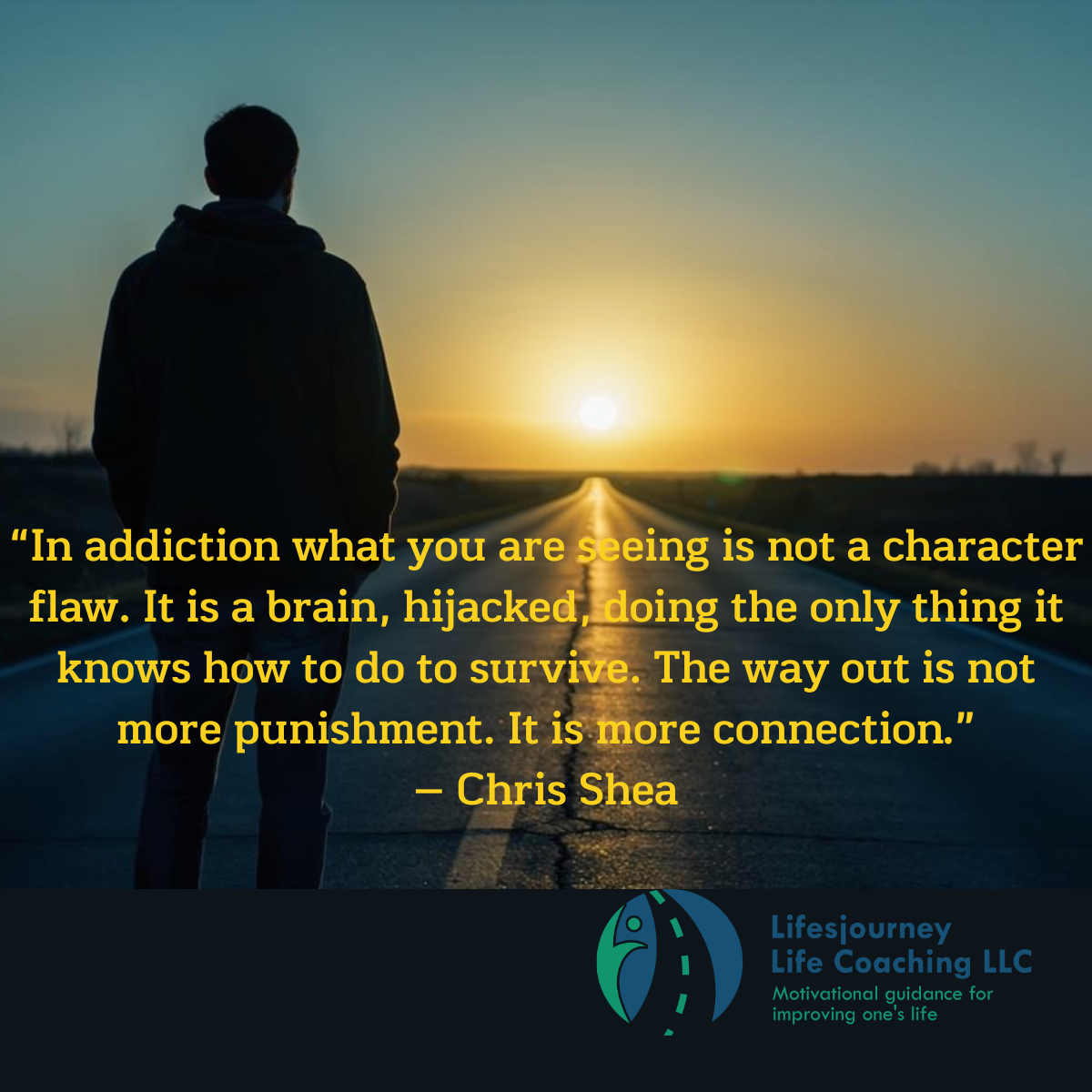
What you are seeing is not a character flaw. It is a brain, hijacked, doing the only thing it knows how to do to survive.
And here is the part the research now confirms: the way out is not more punishment. It is more connection.
I remember a mother — let’s call her Sandy — who came to me exhausted. Her son had been in and out of treatment for five years. She said, “I’ve tried everything. Tough love, ultimatums, paying for rehab, cutting him off. Nothing works.” We spent three sessions talking about her exhaustion, her isolation, her need for support. She started going to Al-Anon. She started sleeping again. And here’s the part that surprised her: her son started calling her again. Not for money. Just to talk. The connection came back when she stopped trying to fix him and started tending to herself.
Why This Matters If You Are the One Struggling
If you are the one in it, reading this between binges, or in the parking lot before a meeting, or at 3 a.m. when the house is quiet — I want you to know something.
I have sat with you. Not literally, but in the way that thirty years of sitting across from people in your exact position makes a counselor know things. I have watched you try to quit. I have watched the part of you that wants to be free fight the part of you that is terrified to be sober, because sober means feeling everything you used the substance to avoid.
That terrified part is not your enemy. It is the part of you that learned, long before the substance, that you had to do this alone. It is the part that does not believe anyone could love you without the performance, the achievement, the mask.
You are not too far gone. There is no such thing. I have seen people come back from an edge I would not have believed possible.
But you cannot do it alone. That is not a slogan. That is biology, sociology, and thirty years of clinical experience talking. The very condition that made the substance attractive — disconnection — is what makes white-knuckle sobriety fail. You need people. You need a path back to yourself. You need a guide who has seen this before.
That is what connection does. It is the medicine. It is also, in its own quiet way, a kind of grace — the kind that shows up when you finally let someone else hold the weight with you.
The Practical Part: What to Actually Do
I promised you practical action steps, and I do not want to disappoint. These are not theoretical. These come from three decades of practice, from the science of 2026, and from what has actually worked for the people I have walked beside.
If You Are the Loved One
1. Stop asking “Why can’t they just stop?” and start asking “What pain are they trying to outrun?”
That single reframe will change the conversations in your home. It is not soft on addiction. It is the truth of addiction. The substance is the symptom. The pain is the wound.
2. Reconnect before you correct.
A person in active addiction cannot hear your logic. They cannot understand your frustration. But they can feel whether you are with them or against them. Before any confrontation, any ultimatum, any intervention — sit with them. Share a meal. Take a walk. Let them know you are staying. The conversation about treatment happens after the connection is rebuilt, not before.
3. Get your own support.
Family members of people with addiction have higher rates of depression, anxiety, and substance use themselves. You are not a spare part. Al-Anon, Nar-Anon, SMART Family & Friends, and family therapy are not optional. They are how you stay well enough to be useful to the person you love.
4. Use connection-based treatment, not willpower-based treatment.
When you help your loved one find help, look for programs that integrate peer support, family involvement, and mindfulness-based or community-oriented care. The 2026 evidence is clear: programs that focus only on the individual in isolation have worse long-term outcomes. Ask any program you are considering: How do you build connection into treatment? If they don’t have a clear answer, keep looking.
If You Are the One Struggling
1. Tell one person. Just one.
Not on social media. Not in a confession. In a real voice, to a real human, in a real room. A counselor. A friend. A clergy member. A sponsor. A doctor. The act of telling is itself the first reconnection. Your nervous system cannot stay in chronic hiding and chronic recovery at the same time. Pick one person. Tell them.
2. Reach for the smallest version of a connection-first step.
You do not have to “get sober today.” You do not have to walk into a treatment center tomorrow. You have to take one step that moves you back toward people. A phone call. A walk to a meeting. A text to the friend you have been avoiding. A page on a treatment center’s website. Small is not weak. Small is how everything that lasts actually starts.
3. Practice the PAUSE before the substance.
In the moments when the craving hits — and it will — try this:
- Pause. Stop for a moment.
- Acknowledge. Notice where you feel the urge in your body.
- Understand. Tell yourself, “I am reaching for relief from a pain I have not yet named.”
- Settle. Take one slow breath.
- Engage. Now choose. Maybe you call someone. Maybe you walk outside. Maybe you just breathe again.
The substance never taught you to ask for help. Mindfulness can. It is not a replacement for treatment, but it is a bridge to treatment, and a daily practice that strengthens the part of you that wants to be free.
4. Build your recovery capital.
“Recovery capital” is the sum of resources that support your recovery — and social connection is the single largest piece of it. Recovery capital includes:
- A safe place to sleep
- At least one person who knows your story
- A purpose (work, volunteer, family, faith, creative practice)
- A practice (meditation, prayer, exercise, journaling)
- Access to a counselor or treatment team
You do not have to build all of this at once. You have to build one piece at a time, and you have to let other people help you build it.
5. Service to someone else.
Paradoxically, one of the most powerful forms of recovery medicine is helping someone in worse shape than you. It doesn’t have to be formal. Check on a neighbor. Show up for a meeting and listen to the newcomer. Service reminds you that you have something to give — and that you belong to something bigger than your own pain.
What I Want You to Hear
I have been doing this work since 1994. I have watched thousands of people fight this disease. Some won. Some lost. Almost all of them, in the end, came to the same conclusion:
The substance was not the enemy. The loneliness was the enemy. The substance was the coping mechanism. Connection was the cure.
The research now agrees. The Surgeon General now agrees. The economists now agree, with their 84-to-1 numbers. The American Medical Association agreed in 1957, when most of the rest of the country wasn’t ready to listen.
We are ready now. Or at least, more of us are.
If you are struggling — you are not alone, and you are not too far gone. If you love someone who is struggling — they are not gone, and you are not powerless. The path out is real, and it is built, plank by plank, out of human connection.
That is what we have been missing. That is what we cannot afford to keep missing.
Call to Action
If you or someone you love is caught in the cycle of addiction and loneliness, please do not try to walk this road alone. Reach out. There are people whose entire life’s work is to walk it with you.
For you — or for someone you love:
- Lifesjourney Life Coaching — I offer one-on-one life coaching and addiction guidance worldwide via video. We work on the underlying pain, not just the symptom. Book a free consultation or call 240-587-7854.
If you want to bring this conversation to your community:
I speak at conferences, workplaces, faith communities, and recovery events nationwide on the connection between loneliness, addiction, and recovery. If you are organizing an event and want a speaker who has lived this work for thirty years, let’s talk about your event or message me on LinkedIn at linkedin.com/in/christophershea1.
If this post moved you, please share it with one person who needs it. That is the smallest version of connection. It is the first step back to someone who has been walking alone.
“The rewards that you get from ‘likes,’ from people reposting your content… they give you a temporary and very short-lived gratification. But what’s different about building real relationships — a connection where somebody knows you for who you are, where you can be authentically yourself — those relationships are extraordinarily protective for our mental and our physical health.”
— Vivek Murthy, Staying Human, 2026