
Why Shrinking Your World Might Be the Path to Inner Peace
There’s a question I’ve been sitting with lately, both in my meditation practice and in conversations with clients: Why do so many of us feel perpetually anxious, even when our immediate lives are relatively stable? I’ve come to believe the answer lies not in what we’re lacking, but in what we’re carrying—an endless stream of information about a world we cannot possibly influence. So I thought about how shrinking your world might be the solution.
The Burden of Knowing Everything
We live in an age of radical transparency. Within seconds of waking, most of us can access detailed accounts of natural disasters on the other side of the planet, political upheaval in countries we’ve never visited, and economic indicators that may or may not affect our daily lives. Social media algorithms feed us a steady diet of outrage and urgency, each notification demanding our attention and emotional response.
Here’s the thing that’s challenging to admit: knowing about every crisis, every injustice, every potential threat doesn’t make us better citizens or more compassionate people. It makes us exhausted. Our nervous systems weren’t designed to process the suffering of eight billion people simultaneously. When we try, we end up in a state of chronic low-grade panic—alert but helpless, informed but paralyzed.
When journalist Johann Hari explored the causes of anxiety and depression, he found that disconnection—from community, purpose, and shared humanity—was one of the central culprits (Hari, Lost Connections, 2018). We’ve become so globally aware that we’ve lost local grounding. We know too much about distant suffering and too little about the people across our street.
What Our Brains Actually Need
From an evolutionary perspective, our anxiety responses developed to handle immediate, tangible threats. A predator in the brush. A storm on the horizon. A sick child in the next room. These were problems we could see, assess, and often do something about. The fight-or-flight response had a clear purpose and a natural resolution.
Today, that same physiological system gets triggered by headlines about events thousands of miles away. Our bodies flood with cortisol and adrenaline, preparing us to act—but there’s nowhere for that energy to go. We cannot fight a wildfire in Australia. We cannot flee from legislative decisions made in distant capitals. So we sit with the chemical residue of unused alarm, day after day, until anxiety becomes our baseline state.
Choosing Presence Over Awareness
I want to be clear about something important: I’m not suggesting ignorance or apathy. What I’m proposing is intentional engagement. There’s a profound difference between being aware of the world’s challenges and being emotionally entangled in all of them simultaneously.
Research suggests that mindfulness practices can lower anxiety and promote well-being, especially when paired with community support (Kabat-Zinn, 2003). The science confirms what many traditions have long taught—that peace isn’t passive; it’s an active, daily practice of attention.
Inner peace, in my experience, comes from recognizing the boundaries of our actual sphere of influence—and then living fully within those boundaries rather than lamenting what lies beyond them. This isn’t selfishness. It’s wisdom. It’s the recognition that our capacity for meaningful action is finite, and that spreading ourselves thin across every cause ultimately serves no one well.
The Practice of Shrinking Your World
So what does this look like in practice? It starts with a gentle but firm curation of where we direct our attention. Consider limiting news consumption to specific times rather than allowing it to intrude throughout the day. Maybe that’s twenty minutes in the morning with your coffee, or a brief check-in after dinner. The world will continue spinning whether you’re monitoring it constantly or not.
More importantly, redirect that freed attention toward what’s right in front of you. Your family. Your neighbors. The elderly gentleman down the street who might appreciate someone checking in on him. The local food pantry that desperately needs volunteers. The community garden that could use your help on Saturday mornings.
These aren’t small things. They’re the actual fabric of human connection and meaning. When you help your neighbor carry groceries, you’ve done something real. When you listen to your teenager talk about their day without glancing at your phone, you’ve strengthened a relationship. When you show up for a friend who’s struggling, you’ve made a tangible difference in someone’s life.
Finding Peace in the Local and Tangible
There’s a particular kind of peace that emerges when we ground ourselves in the immediate and the actionable. It’s not the absence of awareness about broader troubles—it’s the presence of purpose in addressing what we can actually touch.
I think of a client who spent years doom-scrolling through political news, her anxiety mounting with each headline. She felt guilty about not being more involved, yet paralyzed by the scale of everything wrong in the world. Together, we worked on shifting her focus. She started volunteering at a local literacy program, teaching adults to read. Her anxiety didn’t disappear overnight, but something shifted. She could see the impact of her efforts. She built relationships. Likewise, she slept better.
The Ripple Effect of Local Action
Here’s what’s fascinating about shrinking your world: the effects often ripple outward in unexpected ways. When we’re grounded and present, we become better equipped to handle whatever comes our way. We model calm for our children. We bring steadier energy to our workplaces. Not only that, but we notice opportunities to help that we might have missed while absorbed in digital distress.
A peaceful person is a more effective person. Not because they care less, but because they’ve learned to care more strategically—with intention rather than compulsion.
An Invitation to Begin
If this resonates with you, I’d invite you to experiment with this approach. Start small. Choose one day this week to stay offline entirely, or at least limit your engagement with news and social media. Notice what happens in the space that opens up. Maybe you find yourself actually talking to your partner at dinner. Perhaps you take a walk and really see the trees, the sky, the faces of people passing by.
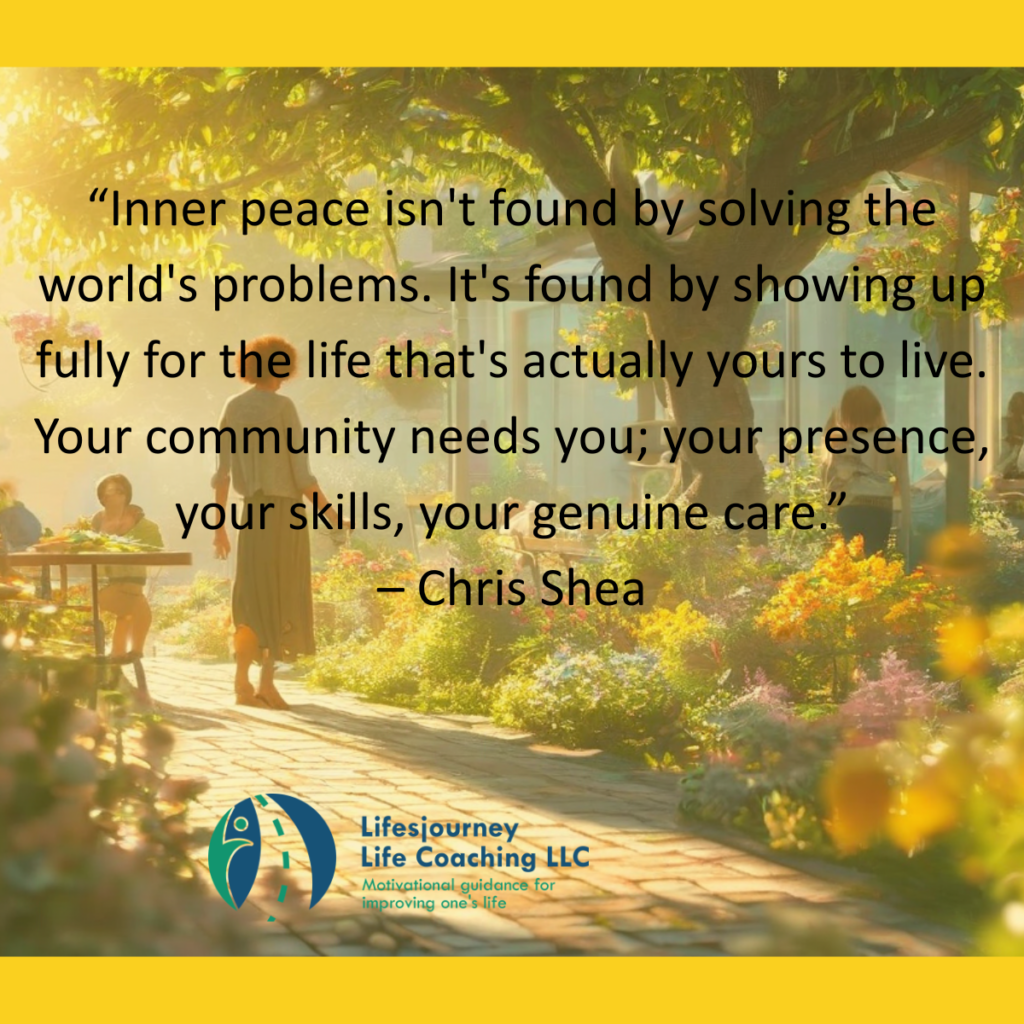
Inner peace isn’t found by solving the world’s problems. It’s found by showing up fully for the life that’s actually yours to live. Your community needs you—not your anxious scrolling, but your presence, your skills, your genuine care. Your family deserves more than the distracted remnants of your attention after you’ve exhausted yourself worrying about things beyond your control.
Shrink your world. Not to hide from reality, but to finally inhabit it.
- Hari, J. (2018). Lost Connections: Uncovering the Real Causes of Depression – and the Unexpected Solutions. Bloomsbury Publishing.
- Kabat-Zinn, J. (2003). Mindfulness-Based Interventions in Context: Past, Present, and Future. Clinical Psychology: Science and Practice, 10(2), 144–156.